Health workers changed to be innovative
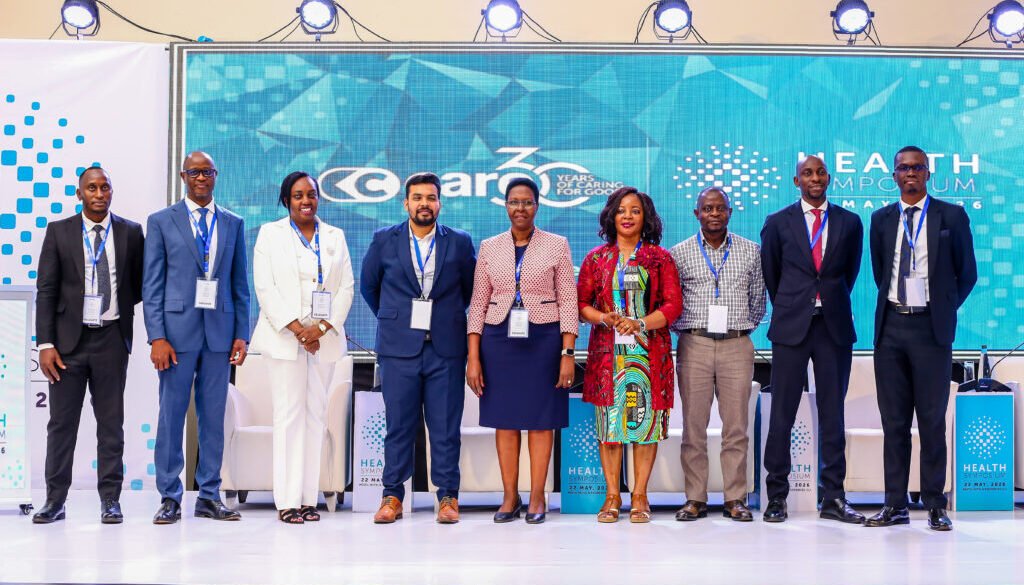
Caption: Rosemary Byanyima, Executive Director of Mulago National Referral Hospital (centre), poses for a group photo with Azhar Sundhoo (5th left), CEO of C-Care East Africa, alongside healthcare professionals and stakeholders during the inaugural C-Care Health Symposium held in Kampala. (Courtesy photo).
By Celia Nsimire
KAMPALA – Health workers have been challenged the sector to rethink the future of medicine beyond hospital walls. The task was made during the 2026 C-Care Health Symposium, held at Mestil Hotel & Residences on Friday May 22nd, 2026 on the theme “Evolution in Healthcare: From Innovation to Excellence,”.
It brought together surgeons, physicians, radiologists, nurses, policymakers, and medical researchers for a full-day exchange on how healthcare systems can adapt to meet changing patient needs in Uganda and across the region.
The discussion ranged from the role of artificial intelligence in diagnostics to the growing need for patient-centred care and stronger emergency systems, Uganda’s healthcare leaders gathered in Kampala this week for a thought-provoking symposium that
The symposium, organised by C-Care Uganda, explored the intersection of innovation, specialised medicine, and compassionate healthcare delivery at a time when Uganda’s health sector continues to grapple with rising disease burdens, increasing patient expectations, and growing demand for affordable, high-quality care.
According to the Ministry of Health, non-communicable diseases now account for nearly 33 per cent of deaths in Uganda, while the World Health Organisation estimates that Africa carries 24 per cent of the global disease burden but has only 3 per cent of the world’s health workers. Those realities framed many of the conversations at the symposium, where experts repeatedly emphasised the need for systems that are technologically advanced, resilient, and humane.
Throughout the day, specialists led discussions on internal medicine, radiology, neurosurgery, emergency medicine, nursing practice, and laboratory diagnostics, while also presenting research abstracts that reflected emerging trends in Ugandan healthcare.
One of the standout sessions was delivered by renowned surgeon and academic, Prof. Moses Galukande, whose presentation examined the evolving role of medical innovation in improving patient outcomes, particularly in low-resource settings.
Prof. Galukande challenged healthcare professionals to embrace innovation as a necessity in modern medicine. “The future of healthcare will not only be determined by the sophistication of our technology, but by how intentionally we use innovation to solve everyday patient challenges,” he said. “Excellence in healthcare is responsiveness, adaptability, research, empathy, and the courage to evolve continuously.”
He further stressed the importance of mentorship and investment in medical research, noting that Uganda’s healthcare system must deliberately nurture young professionals capable of driving scientific advancement locally rather than depending entirely on imported solutions.
The symposium also highlighted the growing role of multidisciplinary collaboration in medicine. Sessions on internal medicine and radiology explored how early diagnostics and integrated care models are helping reduce delayed treatment and improve survival rates for chronic illnesses. Meanwhile, discussions around accident and emergency care underscored the increasing burden that trauma cases continue to place on hospitals. According to the Uganda National Institute of Public Health, road traffic injuries rank sixth among the causes of death among Ugandans, with emergency units across the country experiencing growing pressure due to urbanisation and increased motorisation.
A key moment of the event came during remarks by the Guest of Honour, Dr Rosemary Byanyima, who applauded the symposium for creating a platform where healthcare practitioners could openly reflect on the future of medicine in Uganda.
“Healthcare is evolving globally, and Uganda cannot afford to remain static,” Dr Byanyima said. “We must continue investing in innovation, training, research, and strong health systems that put patients first. Conversations like these are critical because they create the partnerships and ideas needed to strengthen healthcare delivery for all Ugandans.”
She also commended healthcare workers for their resilience amid increasing demand for specialised services, while encouraging stronger collaboration between public and private health institutions to bridge service delivery gaps.
As conversations unfolded throughout the symposium, one recurring theme stood out clearly: the future patient is more informed, more digitally connected, and increasingly expects personalised healthcare experiences. Speakers noted that modern healthcare excellence should be measured by patient experience, communication, accessibility, and trust.
Among those who attended the symposium was paediatrician and public health advocate, Dr Sabrina Kitaka, who delivered a vote of thanks and praised the gathering for reigniting important conversations around healthcare transformation.
“Today’s discussions reminded us that medicine is constantly evolving, and so must we,” Dr Kitaka said. “I also wish to sincerely thank Dr Rosemary Byanyima for her inspiring leadership and unwavering dedication to strengthening healthcare systems in Uganda.”
The symposium concluded with panel discussions, recognition moments, and networking engagements that allowed practitioners from different disciplines to exchange perspectives on healthcare delivery challenges and opportunities.
For many attendees, the lasting takeaway was the growing recognition that Uganda’s healthcare future will depend heavily on how effectively institutions adapt to change while keeping people at the centre of care.
And in an era where medicine is rapidly being transformed by technology, data, and specialised treatment, healthcare excellence is about building systems that are intelligent, inclusive, and deeply human.
Moderated by Sheila Aboth, Manager Brand Experience at C-Care Uganda, a panel discussion on“Healthcare Financing Sustainability” brought together Dr. Andre Mugalu, Dr. Miriam Musinga, Dr. Isaac Musubu, and Dr. Kevin Maracha to examine the future of accessible, high-quality healthcare in Uganda and the region.
The panel underscored the need for sustainable financing models that make advanced healthcare more accessible, emphasising stronger collaboration between healthcare providers, insurers, policymakers, and the private sector. Speakers noted that improving affordability, investing in preventive care, and leveraging innovation will be critical to strengthening healthcare systems and expanding access to specialised treatment for more communities.
The day concluded with remarks from the Chief Executive Officer of C-Care East Africa, who called for greater collaboration between private healthcare providers, government institutions, and academia to drive sustainable improvements in patient care.
“What healthcare needs today is collective intelligence,” the CEO noted. “Innovation becomes meaningful when it improves access, shortens recovery time, enhances diagnosis, and ultimately restores dignity to patients. Our mission at C-Care is not only to expand access to quality healthcare across Uganda, but to help shape the future of healthcare in the country. Over the last 30 years, we haveinvested in stronger systems, specialised medical training, and international standards because sustainable healthcare is built on trust, quality, and people. As Uganda’s economy grows, healthcare must grow with it to meet the needs of a rapidly evolving population.”
About C-Care Uganda
Formerly known as International Medical Group with International Hospital Kampala (IHK) & International Medical Centres (IMCs), C-Care is one of Uganda’s largest private healthcare network, with a tertiary, multi-speciality hospital and 20 clinics across the country delivering easily accessible, affordable, and leading-edge quality healthcare to cater to the changing needs of the growing population. C-Care epitomises medical innovations and quality healthcare, offering easy connectivity and accessibility to patients from Uganda