Ebola outbreak: How safe is East Africa?
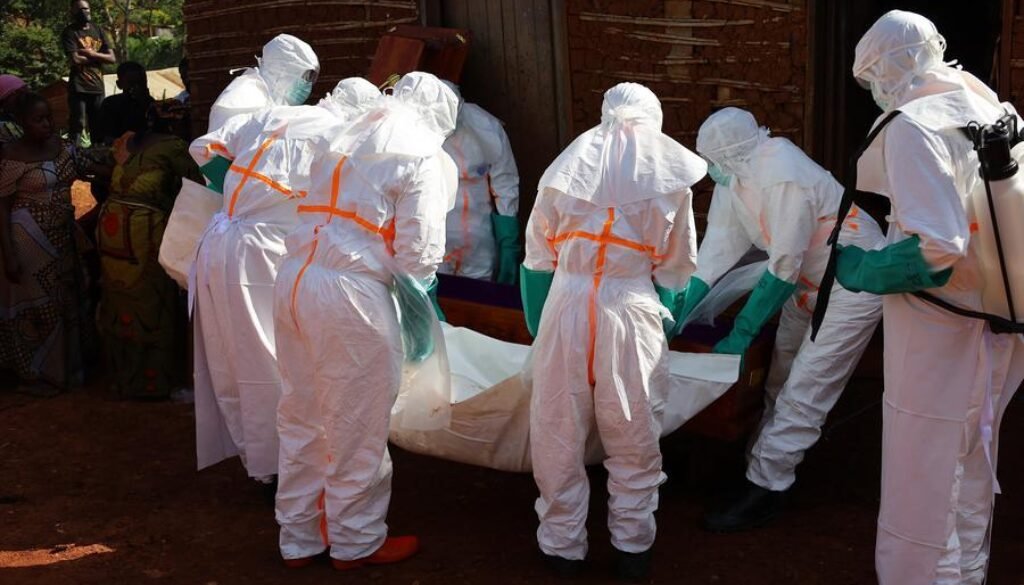
CAPTION: Health workers carry a victim of Ebola in DR Congo recently. (File photo).
By Scott Campbell
Several East African countries have stepped up airport screening and border surveillance after the World Health Organisation declared the Ebola outbreak in the Democratic Republic of the Congo and Uganda a global health emergency, raising concerns for one of Africa’s busiest tourism zones at the start of peak safari season.
Tanzania, Rwanda and Kenya – East Africa’s largest aviation hub and a gateway for millions of tourists heading to destinations including the Masai Mara, Zanzibar and Rwanda’s gorilla trekking routes – all said they had intensified monitoring at airports, land crossings and seaports, despite reporting no confirmed cases so far.
The outbreak, caused by the Bundibugyo strain of Ebola virus, has been centred on the eastern Congo. According to the WHO’s latest outbreak update, on Thursday, 21 May, the DRC had reported 83 confirmed cases and 746 suspected cases, including 176 suspected deaths, while Uganda had reported two cases and one suspected death. Here’s everything travellers need to know.
What is Bundibugyo Ebola?
The outbreak has been caused by the Bundibugyo strain of Ebola virus, a rarer species of the disease first identified in Uganda’s Bundibugyo district in 2007, near the border with the Democratic Republic of the Congo.
Advertisement
Like other forms of Ebola, Bundibugyo virus disease can cause fever, fatigue, vomiting, diarrhoea and, in severe cases, internal and external bleeding. It spreads through direct contact with bodily fluids from infected people or contaminated materials, rather than through the air like Covid-19 or flu.
According to the World Health Organisation, previous Bundibugyo outbreaks have generally recorded lower fatality rates than the better-known Zaire strain, although the disease is still considered highly dangerous and capable of spreading rapidly in areas with limited healthcare infrastructure.
How does Bundibugyo differ from other Ebola strains?
The key difference is that there are currently no approved vaccines or targeted treatments specifically available for the Bundibugyo strain. Most recent Ebola responses, including vaccines deployed during outbreaks in West Africa and the Democratic Republic of the Congo, were developed for the Zaire strain of Ebola virus, which has historically caused the deadliest outbreaks.
Health authorities say those are not formally approved for Bundibugyo virus disease, although the strain is considered somewhat less lethal than Zaire Ebola on average, with historical fatality rates estimated at roughly 25 per cent to 50 per cent, compared with up to 90 per cent in some past Zaire outbreaks. But experts are warning that mortality rates vary widely depending on how quickly cases are detected, how effectively contacts are traced and the quality of local healthcare responses.
How does Bundibugyo Ebola spread?
Bundibugyo Ebola spreads in the same way as other forms of Ebola – through direct contact with the bodily fluids of an infected person or contaminated materials. Crucially, it’s not considered an airborne virus in the way Covid-19, flu or measles are. People generally become infectious only once symptoms begin, which means casual contact, such as briefly passing someone in an airport or sitting near someone without symptoms, is considered much lower risk than direct physical contact with a sick person.
The virus can also spread through contact with infected animals, particularly bats and primates, which is why health authorities advise travellers not to handle bushmeat or wildlife in outbreak areas. Hospitals and funerals have historically been among the highest-risk environments during Ebola outbreaks, particularly where protective equipment, sanitation or infection control procedures are limited. Family members caring for sick relatives are also at a higher risk.
Symptoms can appear anywhere from two to 21 days after exposure and typically begin with fever, fatigue, muscle pain and headaches before progressing to vomiting, diarrhoea and, in severe cases, bleeding and organ failure.
Is it safe to travel to East Africa right now?
For most mainstream tourist itineraries in Kenya and Tanzania, there is still no blanket Ebola-related “do not travel” warning in place. However, the situation is changing quickly, and travellers should distinguish between countries with confirmed cases, countries with enhanced screening, and specific border areas where restrictions or government travel warnings apply.
The WHO has not recommended blanket flight suspensions or entry bans, but it has advised affected countries to strengthen surveillance, introduce exit screening at airports, ports and land crossings, and prevent suspected, probable or confirmed cases – as well as contacts – from international travel apart from medical evacuation. WHO has also advised other countries to provide accurate information and discourage travel to areas with documented Bundibugyo virus detection.
In practice, travellers may encounter health screening, temperature checks, passenger locator forms or questions about recent travel to the DRC or Uganda. Rwanda has introduced stricter entry rules for people who have recently travelled through the DRC, while Uganda has announced temporary restrictions on flights and public passenger ferries running to the DRC.
Has Ebola reached Kenya?
No confirmed or suspected Ebola case has been detected in Kenya. However, Kenya has activated enhanced preparedness and response measures because of the outbreak in eastern DRC and imported cases in Uganda. Kenya’s alert includes intensified screening and surveillance at airports, airstrips, seaports, land border crossings and transit points, as well as the deployment of rapid response teams and emergency operations centres.
Is it safe to travel to Kenya right now?
The UK government has updated its Kenya travel advice to say that travellers arriving in Kenya, particularly from Uganda, Ethiopia and the DRC, may be subject to enhanced health screening because of the outbreak centred in the DRC.
Kenya’s Ministry of Health says it has heightened preparedness and response measures, including enhanced screening at high-risk points of entry, 24-hour laboratory capacity, activated isolation and holding facilities, rapid response teams and cross-border coordination with Uganda and the DRC. For visitors heading to Nairobi, the Masai Mara, Amboseli, Laikipia, Diani, Watamu or Lamu Island, the main practical change is likely to be health screening or questions at arrival, rather than a countrywide travel warning.
Is it safe to travel to Uganda right now?
The CDC currently lists Uganda at Level 1 for Ebola Bundibugyo virus disease, meaning travellers should practice usual precautions, while noting that no vaccine or specific treatment has been approved for Bundibugyo virus disease.
The UK government says travellers may encounter health screening on arrival or departure, including passenger locator forms and temperature checks. It also notes that Uganda’s National Task Force announced temporary measures on 21 May, including the suspension of flights to and from the DRC, suspension of public passenger ferries on the Semliki River between the DRC and Uganda, and suspension of cultural celebrations along the DRC-Uganda border.
Advertisement
Travellers should avoid contact with anyone showing symptoms, avoid funerals or healthcare settings in outbreak areas unless urgent, avoid contact with bodies of people who have died of Ebola or unknown illness, and avoid bushmeat or wildlife.
Is it safe to travel to Tanzania and Zanzibar right now?
Tanzania has not been named as an outbreak country, but travellers arriving from Uganda and the DRC may face heightened health screening. The UK government says Tanzania’s Ministry of Health issued a travel advisory on Monday, 18 May, announcing enhanced screening for travellers arriving from Uganda and the DRC after the WHO declared the outbreak a global health emergency.
Is it safe to travel to DRC right now?
The outbreak has mostly been reported in the eastern DRC, including Ituri, North Kivu and South Kivu, and the CDC has issued a Level 3 Travel Health Notice advising travellers to reconsider non-essential travel to those provinces because of Ebola Bundibugyo virus disease. The UK FCDO advises against all travel to several eastern DRC provinces, including Ituri, North Kivu and South Kivu, and warns that travel insurance could be invalidated if travellers go against FCDO advice. Travellers should avoid non-essential healthcare visits, funerals, contact with dead bodies, traditional healers, bushmeat and wildlife in affected areas, and should monitor for symptoms for 21 days after leaving an outbreak area.
Will travel insurance cover trips to East Africa?
For Kenya and Tanzania, travellers should check whether their itinerary includes any areas where their government advises against travel, as travelling against official advice can affect insurance cover. The FCDO explicitly warns that insurance could be invalidated if travellers go against its advice.
Advertisement
For the DRC, the insurance risk is much higher because the FCDO advises against all travel to multiple eastern provinces, including Ituri, North Kivu and South Kivu. For Uganda, travellers should check whether their policy covers disruption, quarantine, medical evacuation, denied boarding or itinerary changes linked to Ebola screening and border measures.
Rwanda also now needs to be treated carefully in insurance copy, particularly for travellers who have recently been in DRC or whose itineraries include border areas near the country’s borders. Anyone combining safari, gorilla trekking, overland transfers or multi-country East Africa routes should ask their insurer for written confirmation that the full itinerary is covered, including transit points, lodges, internal flights, border crossings and any quarantine-related disruption.