Burundi: ‘A Doctor Told Me to Buy My Coffin’
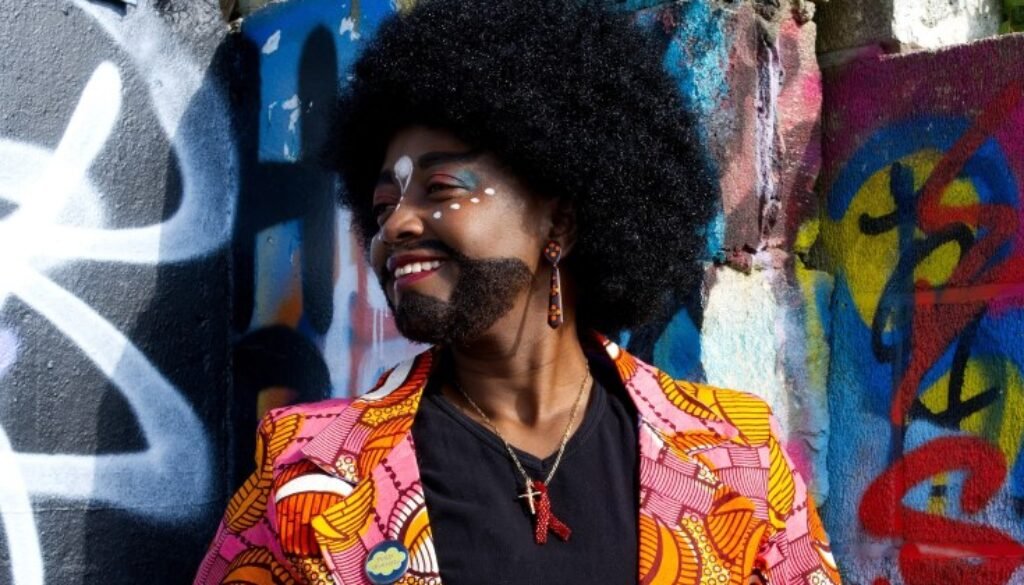
CAPTION: Eliane Becks Nininahazwe, also known as “HIV Stigmafighter,” is a global HIV activist, artist, and performer from Burundi.
How Eric Turned an HIV Diagnosis Into Activism
By Melody Chironda
BUJUMBURA – When Eric was diagnosed with HIV at 26, a doctor told him to plan for his funeral and give up on the idea of children.
Today he’s a husband and the father of two HIV-negative sons, and the world’s first Burundian-Dutch Drag King living openly with HIV, a title he wears as both armor and invitation. “Through art and drag, I fight stigma and raise awareness about PrEP,” he said.
He calls it Dragtivism.
Stigma still shapes who tests, who discloses, who gets treated, and for queer people navigating gender nonconformity alongside HIV, it often comes layered. When Eric the Dragking takes the stage, though, it isn’t just a performance. It’s resistance. Survival. A rewriting of what it means to live with HIV.
In drag, identity is not just performed; it is reconstructed.
“Dragtivism is where drag becomes a vehicle for activism,” he said. “I understood early that art is a powerful tool to raise awareness and fight stigma.” His shows blend dance, storytelling, and symbolism. He’s used his pills as drag makeup to make a point about healthy living and resilience. Every performance carries a message: ending stigma, centering prevention, pushing PrEP and HIV awareness, especially in queer spaces, where he says the need is greatest.
“Ending HIV stigma means centering prevention, so every show carries a message about PrEP, especially in queer festivals where it matters most.”
Drag, for Eric, was never just entertainment. It became the language he used to confront stigma directly.
Sub-Saharan Africa carries the largest share of the global HIV burden – almost 65% of all people living with HIV worldwide. New infections have dropped by roughly 40 to 43% since 2010, real progress – but in 2025 an estimated 1.2 million people were newly infected, and AIDS-related deaths still averaged about one person every minute. The numbers aren’t abstract to Eric. They’re the backdrop his life has played out against.
“I dream of a world where people living with HIV are free from stigma,” he said. “Drag gives me the freedom to embrace who I am and prove I am stronger than the virus.”
That conviction took root after his own diagnosis at 26. “A doctor told me to buy my coffin and forget about children,” he said. “Without treatment, I wouldn’t be here today.”
He didn’t just survive – he built the life he’d been told wasn’t possible. His husband became his lifeline, in the most literal sense, making the trip to South Africa with him every three months so Eric could access care. Eventually they had two sons. Both HIV-negative.
“Stigma pushed me to share my story,” he said. “I wanted young women to see that motherhood is possible, that adherence to treatment saves lives, and that knowing your status is power.”
Call him HIV Stigmafighter or Eric the Dragking – he says it’s the same person, the same mission. “I am the same person, putting the lives of people living with HIV first. Fighting stigma and spreading awareness is my everyday life. Counseling someone to test, and seeing them return with joy after a negative result, fills me with pride.”
His shows double as education. Messages like Undetectable = Untransmittable and PrEP get folded into choreography and dialogue, pulling the audience into the conversation rather than just performing at them.
“I weave them into my art. Sometimes it’s through attributes with key messages, sometimes through dance paired with short speeches,” he said. “U=U and PrEP are powerful tools to melt stigma and promote testing, so they are always part of my stage presence.” Science alone isn’t enough, he said; it has to be embodied, performed, felt.
At the 2022 International AIDS Conference in Montreal, Canada, at a side event called No Pants No Problem, the MC introduced him: “Eric the Dragking is coming to dance HIV stigma away, join him!” What happened next has stuck with him ever since. “The audience erupted, dancing and shouting, ‘Yes, yes, Eric!'” he said. “That moment proved to me that art is the perfect way to show the world that people living with HIV have talent, knowledge, and joy.”
Even with visibility growing, the myths don’t die easily. “In queer spaces, some believe lesbians don’t get HIV,” he said. “But the virus does not discriminate.” Beyond that, he lists off the ones he hears constantly – that people with HIV can’t have children, that healthcare workers need to double-glove around them, that HIV is “from Africa” or only touches sex workers and gay men. “These myths fuel stigma and harm,” he said.
His work is an attempt to replace those narratives with something closer to the truth. “I want people to see the true face of someone living with HIV – healthy, thriving, and proud,” he said. “Stigma is the real enemy, not the virus. My dream is that one day society will accept us fully, and living with HIV will simply mean living a normal life.”
“With good health care, HIV doesn’t kill anymore. But stigma does.”
This year, his show Dance HIV Stigma Away was selected for the International AIDS Conference in Rio de Janeiro, a milestone he doesn’t take lightly. “On that stage in Rio, I want everyone – scientists, policymakers, activists, and the global HIV community – to remember: with good healthcare, HIV doesn’t kill anymore, but stigma does,” he said. “Scientists haven’t found a cure for stigma. Policymakers still allow discrimination. Activists must keep raising noise for access to treatment and prevention. My performance is a call to rise together.”
For Eric, ending the epidemic isn’t only a question of medical breakthroughs. It’s a question of equity, of who actually gets access to testing, treatment, and prevention. “Ending the epidemic feels unrealistic if prevention and treatment aren’t accessible to all,” he said. “Even one person left behind can spread the virus again. For over 40 years, there’s been no cure, and when it comes, who will access it? Rich people first. Meanwhile, children are still born with HIV, and many lack testing or treatment. We cannot end the epidemic while ignoring these realities.”
Peer support, he says, is where a lot of that work actually happens. After a diagnosis, fear can take over, and what cuts through it is hearing from someone who’s already lived it.
“You need someone to say, ‘You are not alone.'” Peers are the ones who answer the real questions: Can I have children? How do I live with medication, day to day? Those conversations correct the myths and prove, in a way statistics can’t, that people living with HIV are healthy, capable, ordinary citizens.
“Silence kills. Stigma kills. Talking saves lives,” he said.