What Dangote’s new refinery means for East Africa
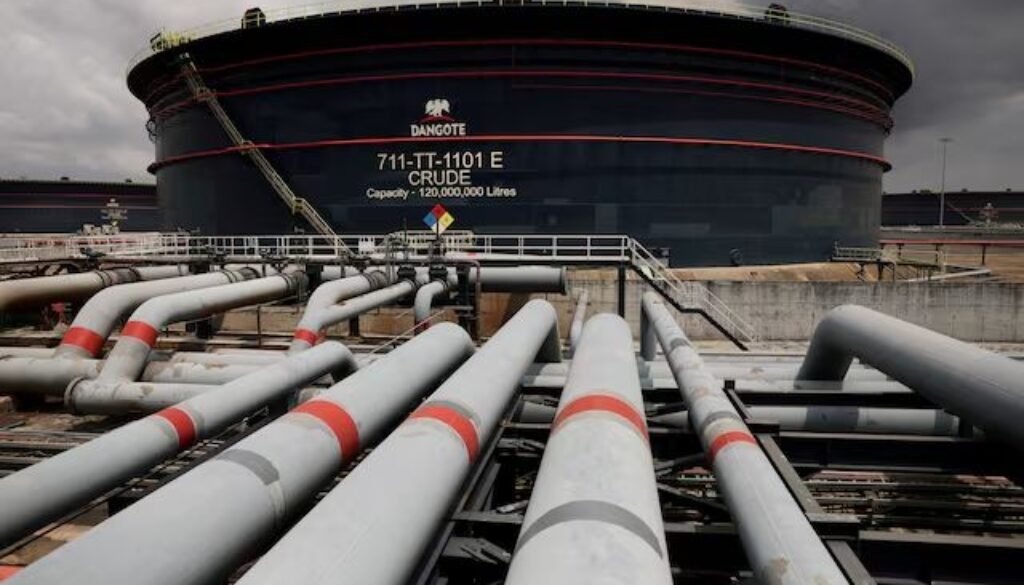
CAPTION: A Dangote crude oil tank is seen inside the Dangote Industries oil refinery and fertilizer plant site in the Ibeju Lekki district of Lagos, Nigeria March 2, 2026. REUTERS/Sodiq Adelakun/File Photo
The facility is set to change not only Kenya but the entire region, with a projected refinery output of 700,000 barrels per day. Once operational, the facility is expected to become Africa’s second-largest refinery.
Oge Onubogu, a director and senior fellow at the Center for Strategic and International Studies in Washington, DC, told DW that “people on the ground [think] it’s wonderful that this investment is coming into Kenya; just the potential about the jobs that could be created, not only for local Kenyan economies but more broadly for the region.”
“It’s a massive project, but one that is needed in many ways on the continent and in the East Africa region,” she said.
Dangote Industries Limited has not yet announced the projected cost of the ambitious undertaking. However, according to Bloomberg, building the proposed refinery could run up a bill of up to $17 billion (€15 billion), making it one of the largest privately funded industrial projects in the region to date.
But what is in it for Dangote?
Negotiations still ongoing
Leo Kemboi, an economist at the Institute of Economic Affairs Kenya, highlights that little is known about the details of the agreement between the Kenyan government and Dangote.
“We’ve not had pronouncements by the government of Kenya on what specific guarantees would be given, but since we’ve seen the many meetings between [Kenyan President William] Ruto and Dangote, we know that certainly there are negotiations that are still ongoing,” he told DW.
“That confirms that there are specific incentives that are up for discussion.”
Dangote Industries intends to fund the project through a mix of internally generated revenue, bond issuances and proceeds from the planned initial public offering (IPO) of Dangote Petroleum Refinery, according to Reuters. However, Nigeria’s Securities and Exchange Commission stated that it has neither received nor approved an IPO application, raising questions about the extent to which the financing process of the facility can be considered a done deal.
According to media reports, Dangote has said that any East African refinery project would require anti-dumping protections to prevent cheaper imported fuels from undercutting local refining operations. That is a prospect that Kemboi worries could backfire.
“If too many [tax] incentives are given to Dangote, it will not be acceptable to any Kenyan, which has happened with many other investments [before],” he said.
“It’s a Kenyan thing. We revolt, or we rebel, when people feel that either you are cheating, or you’re cornering the market — anything that looks suspicious in Kenya is always something that will fail in the end.”
For us to service you better, please leave a comment after reading the story and in case you have a community story you like us to publish reach us on +256752440223 or email: wanderaouma@gmail.com