Dr Congo-Burundi claim Rwanda behind Kenya expulsions
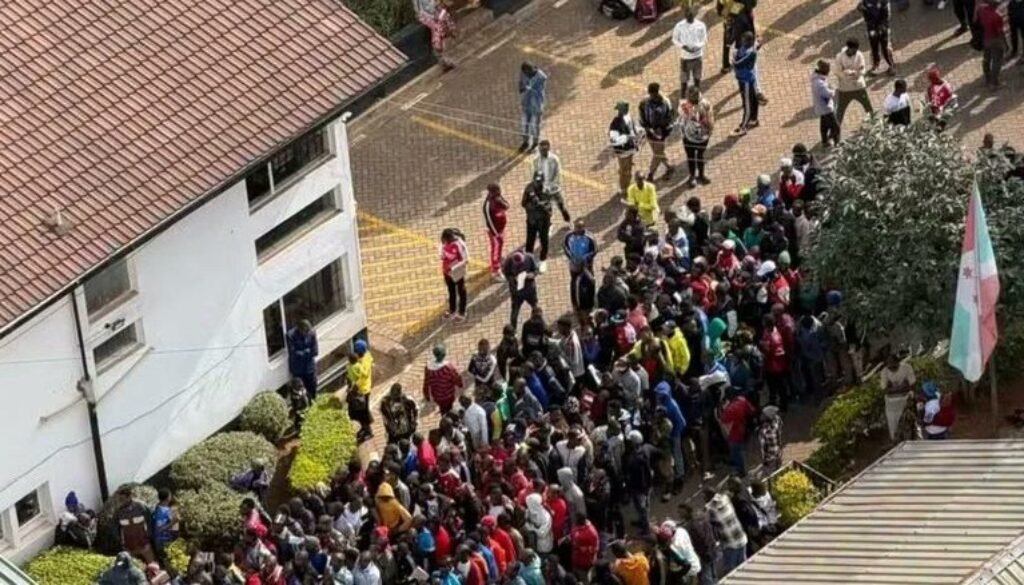
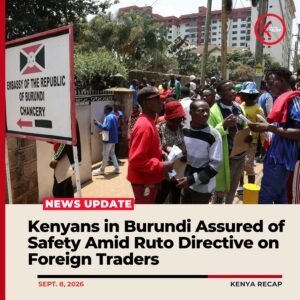
CAPTION: Burundians flocked in the hundreds to their embassy in Nairobi seeking help on September 8th, 2026. (Courtesy photo).
By Our reporter
NAIROBI — A Kenyan crackdown on foreign traders has taken an unexpected turn, with Rwanda now being drawn into a dispute that began as a domestic fight over jobs and small businesses.
The governments and political voices in the Democratic Republic of Congo and Burundi have sought to connect Kenya’s actions against foreign traders to Rwanda.
No evidence has been presented to support that claim.
Kenyan officials have given a different explanation.
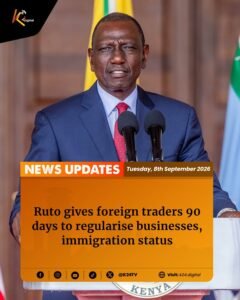
President William Ruto announced the measures on September 2 after meeting Kenyan micro, small and medium-sized traders at State House.
The traders had complained about taxes and growing competition.
Ruto directed authorities to shut down small-scale businesses operated by foreigners from September 7.
He argued that Kenya had worked to attract serious investors.
Such investors, he said, create jobs and expand production.
The government was not seeking foreign nationals to compete with Kenyans in low-capital businesses such as hawking and petty trade.
Kenya’s Trade Ministry later clarified the policy.
The target is foreigners operating businesses without the required work permits and licences.
Visa-free or electronic travel authorisation entry does not automatically give a foreign visitor the right to work or operate a business.
The policy applies to all foreigners in that category.
It is not a general order to expel foreigners.
Foreigners who have the required permits and licences are allowed to continue operating.
Burundians become the face of the crackdown
The announcement nevertheless caused widespread anxiety among foreign traders.
Burundians attracted the most attention.
Large numbers gathered at the Burundi Embassy in Nairobi to seek emergency travel documents.
The Burundi government also announced plans to provide buses for nationals who wanted to return home.
Images of people carrying luggage circulated widely on social media.
Ugandans, Congolese, Rwandans and other foreign nationals were also affected.
Some Ugandans were seen leaving through the Busia border.
Some Congolese and Rwandan traders reportedly closed their businesses or moved.
The concentration of Burundians at their embassy, however, made them the most visible face of the episode.
Many Burundians, including refugees, work in Kenya’s informal economy.
They sell coffee, clothes, snacks and other goods.
Kenyan police have said they have received no confirmed evidence of a mass exodus or organised campaign specifically targeting Burundians, Congolese or Rwandans.
Individual cases of threats and pressure have nevertheless been reported.
Kenya moves to calm fears
The initial announcement also caused concern within Kenya.
Some foreigners reported harassment and threats.
The government subsequently moved to clarify the policy.
Foreign Affairs Principal Secretary Korir Sing’oei visited the Burundi Embassy on September 7.
He apologised for harassment arising from the confusion surrounding the directive.
He also promised greater security in areas with large immigrant populations, including Bahati and Muthurwa in Nairobi.
The government then announced a Documentation and Registration Window for undocumented East African Community nationals.
Government spokesperson Charles Owino said undocumented EAC citizens could present themselves to their embassies or high commissions for registration.
Those who enter the process will be presumed legally present while their status is being addressed.
The government also instructed police to prevent harassment and xenophobia.
The message was increasingly clear.
Kenya wants to enforce immigration and business regulations.
It is not carrying out a blanket expulsion of East Africans.
Then Rwanda enters the story
It is against this background that Rwanda has been pulled into the controversy.
The theory circulating among some political and social-media voices is that the pressure on Burundians in Kenya has a connection to Rwanda.
The claim is particularly sensitive because Burundi and the DRC are closely aligned on the eastern Congo conflict.
Burundi has deployed troops in support of the Congolese government and its allies in fighting AFC/M23.
Kinshasa has also made Rwanda the central subject of its diplomatic campaign over the conflict in eastern Congo.
But the Kenya episode provides no evidence of a connection.
Ruto did not mention Rwanda when announcing the crackdown.
Kenyan ministries have not cited Rwanda as a reason for the policy.
Kenyan officials have instead consistently pointed to jobs, local businesses, work permits and immigration rules.
The Rwanda explanation therefore remains an outrageious allegation rather than an established fact.
Kinshasa’s expanding Rwanda narrative
The development is nevertheless notable because it fits into a much broader pattern.
Kinshasa has increasingly portrayed Rwanda as being behind a wide range of problems affecting the DRC.
The accusations are no longer limited to the fighting in North Kivu and South Kivu.
Rwanda has been blamed in Congolese chaotic political discourse for the M23 rebellion, territorial losses, displacement, insecurity, mineral smuggling and economic exploitation in the east.
Voices allied to the Kinshasa government have also blamed the huge mountains of gabbage in the capital on Rwanda.
More recently, political voices have increasingly sought to connect Rwanda to developments outside the battlefield.
The danger of such a narrative is that Rwanda can become the default explanation for almost any problem affecting the DRC or the wider region.
A political dispute becomes a Rwanda issue.
A security incident becomes a Rwanda issue.
A mineral controversy becomes a Rwanda issue.
A diplomatic disagreement becomes a Rwanda issue.
And now, a Kenyan policy on foreign traders is also being presented by some voices through the same lens.
That does not make the connection true.
It illustrates instead how deeply the Rwanda question has entered the politics surrounding eastern Congo.
Burundi’s position
Burundi has its own reasons for viewing developments involving Rwanda through a security lens.
Relations between Kigali and Bujumbura have deteriorated sharply in recent years.
Burundi has accused Rwanda of supporting armed opponents of its government.
Rwanda has rejected those accusations, explaining that whatever is happening in Burundi is purely internal.
Burundi is also deeply involved in the conflict in eastern DRC.
Its troops have fought alongside forces supporting Kinshasa against M23.
The arrival of Burundian traders at Kenya’s embassy therefore created an opportunity for the economic dispute to be interpreted politically.
But again, there is no evidence that Rwanda caused Kenya to act.
The bigger issue is East African integration
The Kenyan episode exposes a difficult problem for the East African Community.
The region promotes movement of people, labour and business.
At the same time, governments face pressure to protect domestic employment and small businesses.
Kenya is now drawing a distinction between the right to enter the country and the right to work or operate a business.
A visitor may enter without a visa.
That does not automatically give the visitor permission to trade.
The government says foreigners who meet licensing and immigration requirements have nothing to fear.
Those operating outside the rules will face enforcement.
The policy has attracted both support and criticism.
Many Kenyan traders support the government.
They say foreigners are competing with people who are already struggling to survive.
Opposition politicians and civil-society voices have warned that the government handled the announcement poorly.
Some have raised concerns about xenophobia and the potential impact on regional relations.
Others have pointed to reciprocity.
Kenyans themselves live, work and trade across East Africa.
Any restrictions imposed in one country could therefore invite similar measures elsewhere.