Putin agrees to stop recruitment of Kenyans
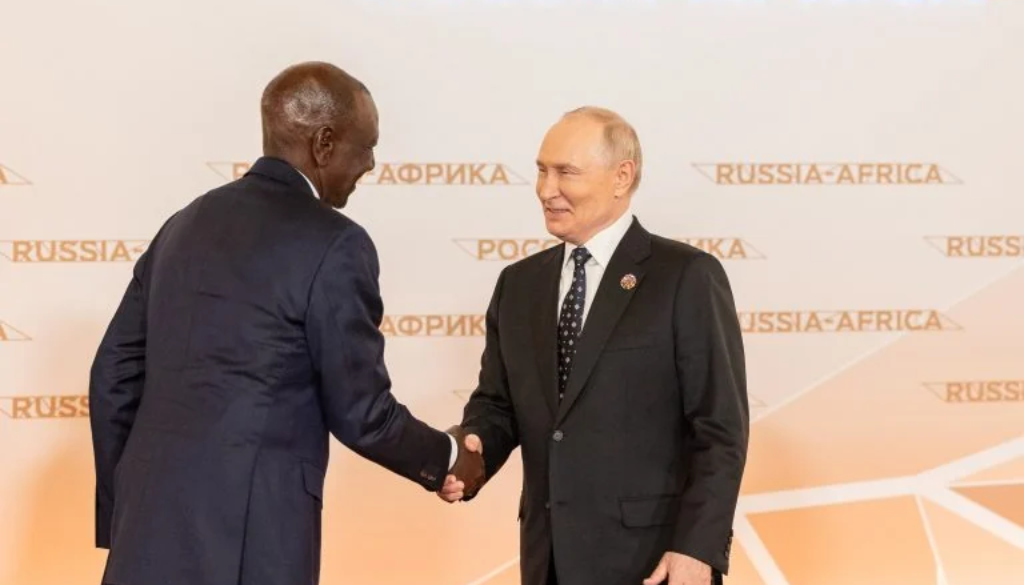
CAPTION: Kenya President William Ruto, left, with Putin, right, at the Kremlin in Moscow on Thursday, October 29, 2026. (Courtesy Photo).
By Agency
MOSCO – Kenya has secured a commitment from Russia to stop recruiting its citizens into the Russian military, as Nairobi steps up efforts to establish the fate of nationals killed, missing or captured while fighting in the war against Ukraine.
President William Ruto announced the agreement following talks with Russian President Vladimir Putin at the Kremlin in Moscow on Thursday, October 29, 2026, according to a statement from Kenya’s State House.
The two countries agreed to designate Kenya as a non-source country for recruitment into the Russian military, in a move aimed at closing channels through which Kenyans have been enlisted to fight on Russia’s side in the conflict.
The agreement follows months of diplomatic engagement by Nairobi amid mounting concerns over the recruitment of Kenyans through networks allegedly offering employment opportunities in Russia.
It also comes as the human cost of the recruitment becomes clearer, with Kenyan authorities reporting deaths, missing nationals and citizens being held as prisoners of war in Ukraine.
“I informed President Putin that I have appointed a Defence Attaché at the Kenyan Embassy in Moscow, who will liaise with the Russian Ministry of Defence to facilitate the repatriation of Kenyans who had travelled to Russia for military purposes,” Mr Ruto was quoted as saying by State House.
The Defence Attaché will also work with Russian authorities to facilitate compensation for affected Kenyans and coordinate the safe return of those seeking to come home.
However, the agreement leaves questions about the fate of Kenyans already deployed to the battlefield, particularly those whose whereabouts remain unknown and families still seeking information about their relatives.
Its effectiveness will also depend on whether recruitment through intermediaries, private agencies and third countries can be prevented.
The agreement follows warnings by Prime Cabinet Secretary Musalia Mudavadi, who disclosed in April that at least 252 Kenyans had been recruited into Russian military operations.
On April 1, while responding to concerns raised in Parliament, Mr Mudavadi said 47 Kenyans had been rescued and repatriated through the Kenyan Embassy in Moscow, while two others were being held as prisoners of war in Ukraine.He warned Kenyans against being lured into foreign military
operations by promises of employment, as the government intensified efforts to dismantle recruitment networks and secure the return of those already enlisted.
On October 9, Mr Mudavadi told a joint sitting of the Senate committees on Labour and Social Welfare and National Security, Defence and Foreign Relations that the government had documented 354 Kenyans linked to the Russia-Ukraine conflict.
Of these, 77 were believed to be on the frontline, 38 were in military camps, 52 were in unknown or unclassified locations and 34 were hospitalised.
Another 62 had been repatriated, while five were confirmed to be prisoners of war in Ukraine.
The remaining 84 were reported killed or missing in action. However, the government cautioned that the two categories were different and that some deaths had yet to be verified.
The figures underline the challenge facing Nairobi as it seeks to establish the whereabouts of affected citizens, provide assistance to their families and facilitate the return of those still in Russia or Ukraine.
Compensation and repatriation
The latest announcement gives fresh political weight to Kenya’s efforts to address the recruitment crisis, although the practical arrangements for compensation and repatriation remain unclear.
The government has not announced the amounts that may be paid, the criteria for eligibility or a timetable for completing the process.
Mr Mudavadi previously told Parliament that Russia had indicated it could not meet the cost of repatriating the remains of deceased Kenyans, meaning arrangements would have to be handled on a case-by-case basis.
The Defence Attaché’s role will therefore be important in coordinating with Russian authorities, establishing the status of affected nationals and facilitating discussions on their welfare and return.
The agreement also raises questions about how Kenya and Russia will address cases involving citizens recruited through unofficial channels, particularly where families have struggled to obtain reliable information about their relatives.
Trade and investment ties
Beyond the military recruitment issue, the Moscow meeting focused on strengthening economic relations between Kenya and Russia.
Mr Ruto acknowledged the trade imbalance between the two countries, which favours Russia, but said Kenya wanted to expand exports, particularly tea and flowers, to the Russian market.
“I recognise there is a trade imbalance in favour of Russia, but there is an opportunity to look at what other trade avenues we can explore,” he said.
He also invited Russian investors to consider opportunities under Kenya’s proposed National Infrastructure Fund, which is intended to support infrastructure development through commercially viable investments and private sector participation.
Mr Putin reaffirmed Russia’s commitment to expanding economic, cultural and humanitarian cooperation, identifying fertiliser exports as an important component of existing trade relations.
“Russia is one of the top fertiliser exporters to Kenya. I reiterate that we need to preserve this trend. We maintain fruitful cultural and humanitarian ties between our countries,” he said.
The Russian President also announced an increase in scholarships for Kenyan students seeking higher education in Russia, from 70 to 300 annually.
The two countries signed five memorandums of understanding covering economic cooperation, labour inspection and employment promotion, transport, diplomatic training and visa-free travel for holders of diplomatic and service passports.
The agreements include the establishment of an Intergovernmental Russia-Kenya Commission on Economic Cooperation and cooperation between Russia’s Federal Service for Labour and Employment and Kenya’s Ministry of Labour.
The labour agreement could provide a framework for strengthening employment cooperation and labour protection, although its effectiveness will depend on implementation and safeguards against recruitment abuses.
The two leaders also discussed international cooperation, including reform of multilateral institutions, the role of the United Nations and Russia’s support for strengthening the United Nations Environment Programme headquarters in Nairobi.
The recruitment agreement is expected to be judged by whether it prevents further enlistment of Kenyans into the Russian military and helps resolve outstanding cases involving those already caught up in the war.