Value addition a way to economic sovereignty – Oboth
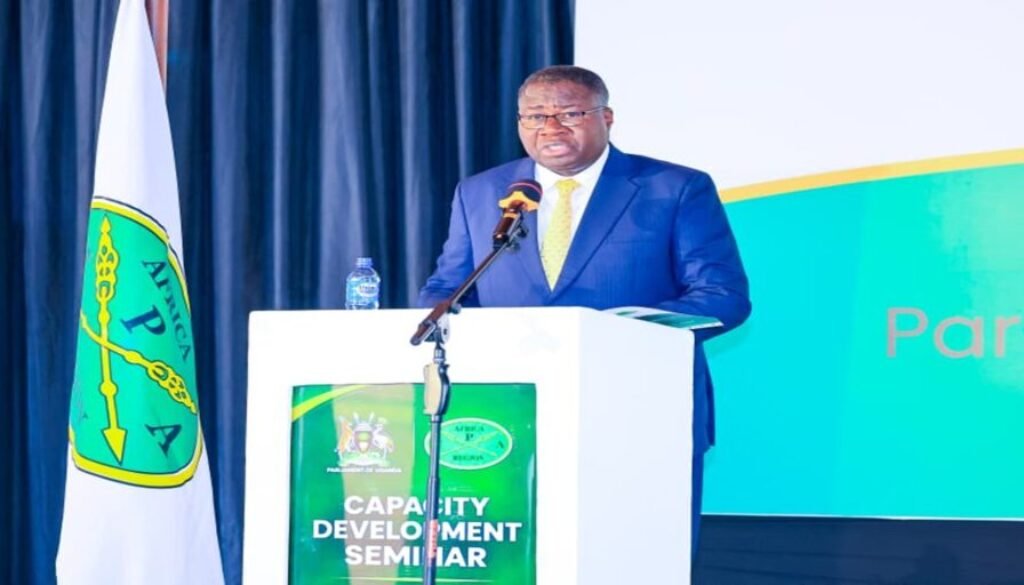
CAPTION: Speaker Oboth addressing delegates from across the African continent in Entebbe on Tuesday November 10th, 2026. (Courtesy Photo).
By Our reporter
ENTEBBE – Speaker Jacob Marksons Oboth has urged legislators to push for value addition over the export of raw materials, saying the African continent cannot secure true economic sovereignty while processing, manufacturing and profits accumulate elsewhere.
Oboth made the call while opening the Commonwealth Parliamentary Association (CPA) Africa Region Capacity Development Seminar at the Imperial Botanical Beach Hotel in Entebbe.
The seminar running between 09 and 13 November 2026 is being held under the theme, ‘From Extraction to Transformation: Parliamentary Leadership in Securing Africa’s Resource Wealth for Sustainable Development’.
“The tragedy of Africa is not the absence of wealth; it’s our failure to transform that wealth into prosperity for our people,” Oboth said adding that, ’we extract and export raw materials while processing, manufacturing, employment, and profits largely accumulate elsewhere’.
He added that the responsibility to drive the shift lies with the legislators urging them to use their legislative, budgetary and oversight powers to ensure greater accountability in the management of Africa’s natural resources. The Speaker called on all parliamentarians to scrutinise extraction contracts, enforce local content laws and close loopholes that facilitate illicit financial flows.
“Communities must participate in decisions affecting their livelihood, benefit from resource extraction in their area and be protected against displacement and environmental degradation,” he added.
According to the Oboth, the real benefits of natural resources are fully realised only when they are converted into finished products that create industries, employment and greater market value.
Using coffee and crude oil as examples, he explained that their economic potential extends beyond cultivation and extraction to processing, packaging, marketing and the industries that generate jobs and wealth.
Highlighting Uganda’s efforts under President Yoweri Museveni, Oboth pointed to government initiatives promoting local processing of agricultural commodities such as coffee, maize and cocoa, restricting the export of raw minerals and strengthening local content requirements in the oil and gas sector.
He however, cautioned that the African Continental Free Trade Area (AfCFTA), despite presenting significant opportunities for expanding intra-African trade, will only achieve its full potential if member states prioritised value addition and moved away from dependence on exporting unprocessed raw materials.
Hon. Kabasharira (R) sharing a light moment with her Ugandan colleague, Hon. Patrick Oshabe at the start of the seminar
The Chairperson of the CPA Uganda Branch, Hon. Naome Kabasharira said the seminar comes at a time as natural resources drive regional economic transformation.
She outlined areas of parliamentary oversight of extraction contracts and licensing, local content laws that give citizens a stake through jobs, skills, enterprise and ownership; value addition and beneficiation; and measures to curb illicit financial flows and aggressive tax avoidance.
“As parliamentarians, we are acutely aware that the mere existence of natural resources is not automatically translated into broad development and improved livelihoods for our citizens,” she said.
She identified illicit financial flows and aggressive tax avoidance as significant threats to Africa’s development ambitions, noting that weak governance, opaque transactions and profit shifting continue to deprive governments of resources needed to finance healthcare, education, infrastructure and social development.
The delegates attending the CPA seminar in Entebbe, has brought together legislators from South Africa, Rwanda, Nigeria, Tanzania, Zambia and the host Uganda.