Late Musoba steered national HIV response
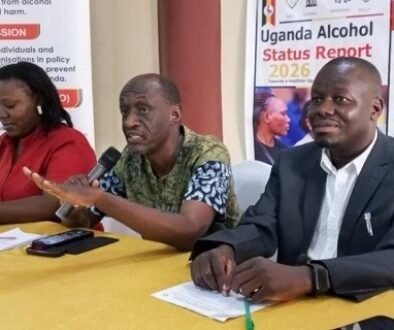
KAMPALA – Dr Nelson Musoba had become a familiar face at press briefings on Uganda’s HIV/AIDS response, often appearing whenever the Uganda AIDS Commission or the Uganda Media Centre organised engagements to update the public on the country’s progress and challenges in the fight against the epidemic.
His absence from two important engagements this month, however, went largely unexplained. Back at URN, questions about his absence were visible.
Early November, when the Uganda AIDS Commission and the Uganda Media Centre convened a press briefing to outline preparations for this year’s World AIDS Day, Musoba was absent.
Unlike previous engagements, he was represented by Tom Eti, a Senior Manager in charge of Coordination at the Commission.
He was also expected to feature prominently at the 2026 National HIV and AIDS Symposium, held from November 16 to 18 at Mbarara University of Science and Technology (MUST).
But Musoba did not attend the meeting, and no official explanation was provided for his absence.
The symposium was intended to review Uganda’s progress under the National HIV Strategic Plan, discuss the sustainability of HIV financing amid declining external support and share scientific research to inform the country’s response.
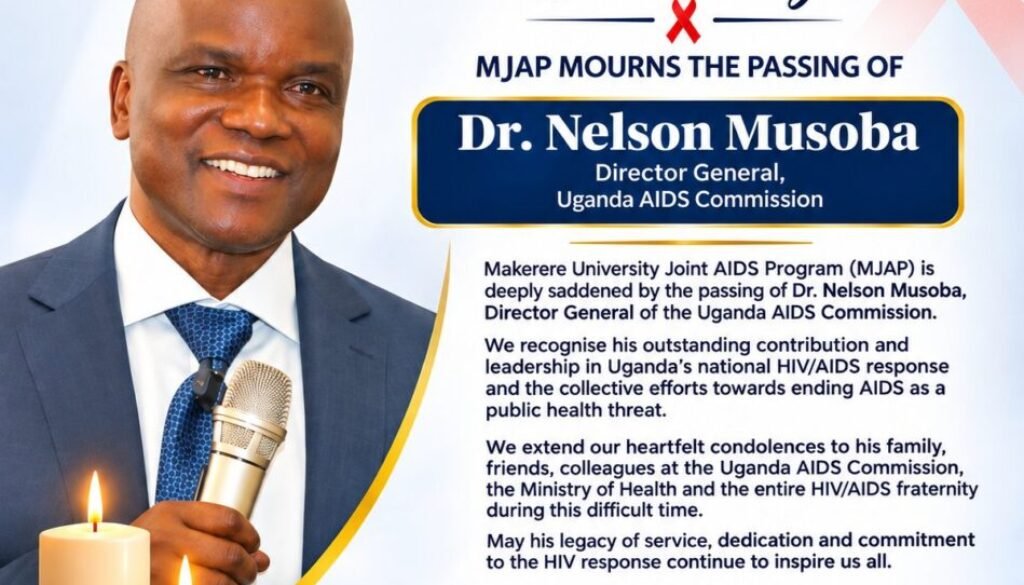
The two absences were followed by an announcement of his death on Sunday morning, November 22.
The Minister for the Presidency, Milly Babalanda, announced that Musoba had died at 5:45 a.m. at Medipal Hospital in Kampala, where he had been receiving treatment for cancer-related complications.
In a message posted on X, Babalanda wrote:“With deep sorrow and profound sadness, I announce the untimely passing of the Director General of the Uganda AIDS Commission, Dr. Nelson Musoba.”
She conveyed the news to President Yoweri Kaguta Museveni, the staff of the Uganda AIDS Commission and the entire country.
“His passing comes at a particularly critical time as the country prepares to commemorate World AIDS Day on 1st December, a moment when we reflect on the progress made and the challenges that remain in the fight against HIV/AIDS,” Babalanda wrote. She said Musoba’s dedication, commitment and contribution to Uganda’s fight against HIV/AIDS would be remembered, adding that his service had left an enduring legacy in strengthening the national response.
The Uganda AIDS Commission announced his death in a statement issued about two hours later.
“On behalf of the Management and Board of UAC, we inform you about the untimely passing of the Director General UAC, Dr. Nelson Musoba. We will communicate other details in due course. May His Soul Rest in Peace,” the statement read.
Information obtained by Uganda Radio Network indicates that Musoba had applied for sick leave after his officail leave from the Commission to pursue further medical examinations and treatment.
A source close to the family told URN that Musoba had sought treatment at the Uganda Cancer Institute after being diagnosed with what appeared to be colon cancer.
According to the source, Musoba underwent an operation at a hospital in Nairobi, Kenya, before being brought back to Uganda.
The source said the cancer-related infection had spread to other organs, after which he was placed under palliative care.
The source was among a few close relatives who visited him on November 16 at Medipal Hospital, where he was receiving treatment. The sources indicated that the late patient told them that he knew that he was not going to live longer.
The relative told URN that the family was surprised by the speed at which the illness had progressed, particularly because Musoba had been keen on undergoing routine medical examinations.
The specific diagnosis and details of his treatment have not been independently confirmed by the family or the Uganda AIDS Commission. Babalanda’s announcement identified cancer-related complications as the cause of his death.
Musoba had worked in the health sector for over twenty years, gaining experience in health systems management, policy development, donor coordination and public-private partnerships.
Between 2007 and 2012, he served as Senior Health Planner at the Ministry of Health, where he was responsible for coordinating the Uganda office of the Global Fund programmes for HIV/AIDS, tuberculosis and malaria.
Before joining the Uganda AIDS Commission, he worked as Project Director and Chief of Party for the Monitoring and Evaluation of the Emergency Plan Progress (MEEPP) project.
The USAID-funded initiative was established to provide technical support to the United States government in monitoring and evaluating the President’s Emergency Plan for AIDS Relief (PEPFAR), while supporting national monitoring and evaluation systems under the “Three Ones” principle.
Musoba joined the Uganda AIDS Commission in 2014 as Director of Planning and Strategic Information, where he coordinated the directorate responsible for planning and strategic information.
In March 2017, he was appointed Acting Director General of the Commission, a position he held until February 2018, when he was confirmed as Director General.
As head of the Commission, he was responsible for an institution mandated to provide strategic direction and coordinate Uganda’s multisectoral response to HIV/AIDS. The work involved coordination with government ministries, local governments, development partners, civil society organisations and communities affected by HIV.
Musoba’s death comes at a time when Uganda is seeking to consolidate its gains against HIV/AIDS while addressing persistent new infections, inequalities in infection rates and uncertainty over the sustainability of funding for HIV programmes.
At the November 4 press briefing, where he was represented by Tom Eti, the Commission outlined preparations for the National HIV and AIDS Symposium and the December 1 World AIDS Day commemoration.
The HIV situation presented by Dr Vincent Bagambe, the Commission’s Senior Manager for Policy, Planning and Strategic Information, showed that Uganda had an estimated 1.567 million people living with HIV.
Bagambe reported that new infections had reduced from 38,000 to approximately 34,000. However, young people aged 15 to 24 accounted for 38 per cent of the new infections, while adolescent girls and young women continued to carry a disproportionate burden.
The figures also showed regional inequalities, with HIV prevalence estimated at 8 per cent in southwestern Uganda, 7.3 per cent in southern Uganda and 7.2 per cent in northern Uganda.
Bagambe explained that the burden was also concentrated among key populations, including female sex workers and their clients, fishing communities, truck drivers, people who inject drugs and men who have sex with men.
The symposium, held from November 16 to 18, was organised around the theme, “Sustainable Interventions to End AIDS as a Public Health Threat by 2030.”
Its programme included the annual joint AIDS review, a financing dialogue, scientific meetings and the Philley Bongole Lutaaya memorial lecture.
The financing discussions were particularly important as Uganda sought to strengthen domestic funding for HIV programmes amid reductions in external support.
The symposium also reviewed the country’s performance under the National HIV Strategic Plan and identified interventions needed to achieve the target of ending AIDS as a public health threat by 2030.
News of Musoba’s death has drawn tributes from government institutions, international organisations and civil society groups involved in Uganda’s HIV response.
The Ministry of Health described his death as a loss to the country’s health sector, saying it honoured his years of dedicated service and leadership in the fight against HIV/AIDS.
In a statement, UNAIDS Executive Director Winnie Byanyima described Musoba’s death as a tremendous loss to Uganda’s public health community and the international partners who worked with him.
“Throughout his leadership at the Uganda AIDS Commission, Dr Musoba demonstrated an unwavering commitment to strengthening the national HIV response, ensuring that it remained a national development priority,” Byanyima said.
UNAIDS said Musoba helped guide Uganda’s HIV response through a period of change, as global funding shifted and the country worked to ensure that HIV services could continue over the long term.
The organisation credited him with championing national ownership, stronger coordination and partnerships across government, development partners, civil society and communities.
“For UNAIDS, Mr Musoba was more than an institutional counterpart; he was a trusted partner and colleague whose wisdom and dedication to the national HIV response helped advance our shared mission of ending AIDS as a public health threat by 2030,” the statement added.
The Centre for Health, Human Rights and Development (CEHURD) also extended condolences to Musoba’s family, colleagues and friends, describing his contribution to Uganda’s HIV response and the advancement of public health as significant.
The Uganda Network on Law, Ethics and HIV/AIDS (UGANET) recognised his leadership and contribution to the national response, saying his stewardship helped build an institution whose work and continuity stand as a testament to his leadership.
The Jinja Network of Young People Living with HIV described him as a giant whose leadership, wisdom and strategy would not be forgotten.
Other organisations, including the AIDS Information Centre Uganda and the Centre for Women Justice Uganda, also joined the country in mourning his death.
Dr Musa Lumumba, in a message posted on X, said Musoba’s leadership and years of service had strengthened Uganda’s national HIV/AIDS response and public health systems.
Musoba’s death leaves the Uganda AIDS Commission without the Director General who had led the institution through years of efforts to reduce new infections, expand treatment and strengthen coordination among the different actors in the national HIV response.
His death also comes less than two weeks before World AIDS Day, when Uganda will once again take stock of its achievements and the challenges that remain in the fight against the epidemic.
Babalanda said further information regarding burial arrangements would be communicated in due course.