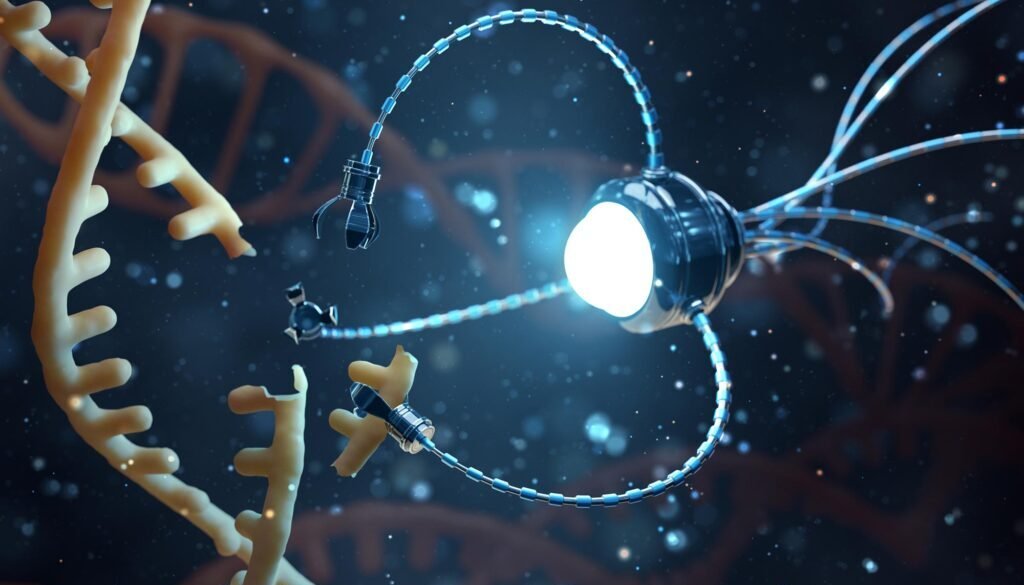
DNA Robots are coming that could transform medicine and technology
Scientists are exploring DNA-based robots, tiny molecular machines that could one day navigate the body, deliver targeted therapies, and even build nanoscale technologies.
That promise is exciting, but the technology is still in its early stages. Most DNA robots remain proof-of-concept systems rather than practical tools. Even so, the field is advancing as scientists learn how to design DNA structures that can bend, fold, and move in controlled ways.
A new review examines how researchers are building these machines using several design strategies. Some DNA robots rely on rigid joints for stability, while others use flexible components or folding structures inspired by origami. By adapting familiar ideas from large-scale robotics to the nanoscale, scientists are beginning to create molecular devices that can carry out specific tasks more reliably.
How to control DNA robots
Building these devices is only part of the challenge. They also need ways to move and respond reliably in a microscopic world dominated by constant molecular collisions. To make that possible, researchers have developed control methods that use both chemistry and physics. The review highlights biochemical techniques such as DNA strand displacement, along with external triggers including electric fields, magnetic fields, and light.
DNA strand displacement gives scientists a way to program action into the machine itself. By designing “fuel” and “structure” DNA strands that interact in precise sequences, researchers can trigger movements or changes in shape with remarkable accuracy. In effect, the robot can be encoded to follow molecular instructions.
Applications Beyond the Lab: Medicine, Manufacturing, and More
The medical potential is one of the field’s biggest draws. DNA robots could one day act like “nano-surgeons,” finding specific cells in the body and delivering treatment directly to them. In theory, this kind of precision could make therapies more effective while reducing harm to healthy tissue. Researchers have also explored DNA devices that can capture viruses such as SARS-CoV-2, hinting at future systems that could combine detection and treatment in a single platform.
The technology could also have a major impact outside medicine. In atomic manufacturing, DNA robots may serve as programmable templates that position nanoparticles with sub-nanometer precision (less than one billionth of a meter). That could help scientists create molecular computers and optical devices with capabilities beyond what current manufacturing methods can easily achieve.
Challenges Ahead: Scaling and Integration
Despite the progress, major obstacles remain. Brownian motion makes precise control difficult, and many current DNA robots are still static, isolated systems with limited functionality. The field also lacks strong supporting infrastructure, including detailed databases of DNA mechanical properties and simulation tools that can accurately predict how these machines will behave.
The researchers behind the review argue that solving those problems will require collaboration across multiple fields. They point to standardized DNA “parts libraries,” AI-assisted design simulations, and improved bio-manufacturing methods as key steps toward making DNA robots more capable and scalable.
“The robots of tomorrow won’t just be made of metal and plastic,” says the research team. “They will be biological, programmable, and intelligent. They will be the tools that allow us to finally master the molecular world.”