Besigye cash: Shs59.3 million spent to transcribe
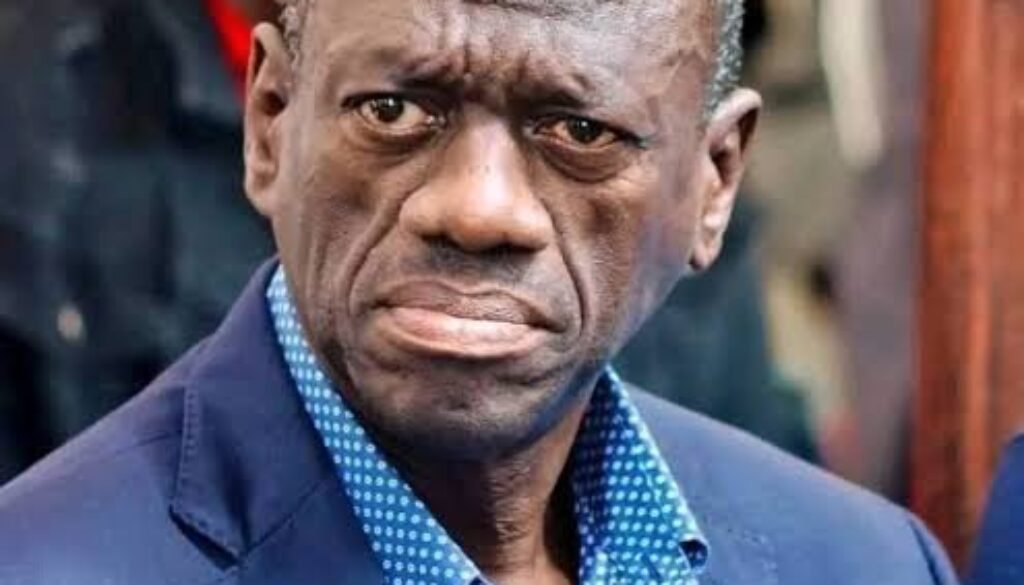
CAPTION: Dr Kizza Besigye at the High Court in Kampala where they face treason charges. (File Photo).
By Our reporter
KAMPALA – The High Court in Kampala has heard that the Criminal Investigations Department of Police paid UGX 59,300,000 to Makerere University’s Institute of Languages Project Account for transcription services of audios and videos arising from various meetings in which jailed Dr Kizza Besigye and others discussed a treason plot.
This was on Thursday before the Criminal Division Judge Emmanuel Baguma. It has been revealed by the Second Prosecution witness Medadi Ssentanda Erisa a 46-year-old resident of Kilyagonja, Matuga Wakiso District.
Ssentanda is a Senior Lecturer at the Makerere University Department of African Languages, Literature and Communication. He is also the Coordinator for Languages and Communication Services at the Institution.
In his testimony on Thursday afternoon, Ssentanda who also holds a PHD in General Linguistics has told the court that on September 5th 2025, he received a request from the Deputy Director CID/SID to transcribe audio and video recordings.
He said they were on a flash disk memory stick silver in color and inside a brown envelope bearing words on top CID Headquarters Reference; E/033/05/09/2025 (KB). Ssentanda said that like always, he inserted the flash disk into a computer in order to come up with the cost of the services the CID wanted transcribed into text.
He said at that time, it was 70,000 shillings per minute of audio.He said that the money was received and a receipt issued and upon opening it, they found a folder named 180-2025 where inside it were five sub folders named Meeting 01 Geneva, Meeting 02 Geneva, Meeting 03 Geneva, Meeting 04 Anthens and Meeting 05 in Nairobi.
Court has heard that all these recordings each was running for different minutes ranging from two hours two nine hours.
The witness has told Court that in total, the recordings he received were running for 25 hours, 21 minutes and 3 seconds and therefore billed at 59, 320,000 shillings in order for them to be transcribed into text.
He said the moment money was paid by the client, a Linguistic was assigned to do the transcription services and a report was given to the client on October 7th 2025.
To prove this, Ssentanda has showed Court his forwarding letter to the Deputy CID/SID referenced CLCSDC/JO-33/05/09/2025 showing how they received the said monies on the Makerere Institute of Languages Project Account and as such, they were giving them their report.
“We therefore forward to you the transcription of the above referenced files for your purposes. The transcription is accurate to the best of our knowledge”, reads the report signed by Ssentanda. The voluminous report sealed and stamped from Makerere has also been displayed on the Court’s big Screens using projectors for everyone to see.
However, trouble came when the Prosecution led by Richard Birivumbuka Chief State Attorney accompanied by the Assistant Director of Public Prosecutions asked Court to be allowed to tender in the said report.
The Defense team led by Farooq Kizito Kamulegeya objected to this saying that the transcription had no source and that they didn’t know where it was coming from as it was never tendered in Court previously by anyone.
The defense lawyers cited several laws such as the Electronic Evidence Act and the Electronic Transactions Act to support their arguments.
They have told Judge Baguma that the report arises from a flash disk not yet tendered which violates section 7 (2) of the Electronic Evidence Act as well as section 61.
Court has had lengthy arguments to the effect that a person seeking to introduce data electronically has a burden to prove its authenticity by evidence to show that it is actually what the person claims it to be. In other words, the defense said that the witness Ssentanda doesn’t own the evidence he wanted to present and therefore the chain of custody shouldn’t be broken by allowing his report.
In his response, State Attorney Birivumbuka said the objection was misplaced in totality. He said Prosecution wanted to tender a report authored and signed by the witnesses himself. He said the objection is on the flash disk whose application they (State) hasn’t yet made.
Birivumbuka said for now, the objection is baseless and the same should be dismissed.
However, since it was already late past Court’s working hours, the Judge has decided to adjourn the case to September 23rd 2026 for him to deliver his ruling and further hearing of the case.
Meanwhile earlier on, the Prosecution’s first witness Andrew Wilson (AW),a Kurdish Private Investigator who recorded the alleged treason meetings involving Besigye and others concluded his testimony after nearly two months in Court. He was then discharged as the State continues to bring more witnesses.
The treason trial is proceeding in the absence of Dr. Besigye who is on remand at Luzira prison. The Prosecution is being represented by Assistant Director of Public Prosecutions Thomas Jatiko and Chief State Attorney Richard Birivumbuka in this case.
On the other hand, Lutale is being represented by a team comprised of Wilson Kato, his young brother Farouq Kamulegeya, daughter Mariam Lutale and Syrus Ogul.
Lawyers Sylvia Namawejje Ebitu, Julius Sserwambala and Sarah Awelo appear for Captain Denis Oola.
Besigye, Lutale and Captain Oola are jointly charged with treason over allegations that they plotted to overthrow the government.
According to the prosecution, the trio held meetings in Uganda, Kenya, Greece and Switzerland to solicit funding, acquire weapons and organise paramilitary activities. Prosecutors further allege that Besigye met an alleged Kurdish intelligence operative identified as Andrew Wilson and received US$5,000 to facilitate the transportation of 36 Ugandans to Kisumu, Kenya, for military training, although the recruits were allegedly intercepted and deported before the training commenced.
The State also alleges that Besigye sought to acquire surface-to-air missiles, ricin poison and counterfeit currency, and planned to use drone technology to assassinate President Yoweri Museveni.
The prosecution says it intends to rely on witness testimony, audio and video recordings, social media communications, immigration records and telephone data as evidence during the trial.
Share on: