Kenya gives Rwanda land to boost trade
By Sam Nkurunziza
NAIROBI – Rwanda’s relationship with Kenya has become increasingly anchored in the infrastructure through which its trade, energy supplies and investment move, with Kigali now maintaining a physical presence at strategic points along the Northern Corridor.
Among the arrangements highlighted during the 10th Kenya-Rwanda Joint Permanent Commission for Cooperation (JPCC) in Nairobi was Kenya’s allocation of land to Rwanda at Miritini and Naivasha.
The sites place Rwanda closer to two important points in the logistics chain linking the Port of Mombasa to the landlocked country and other inland markets. This points towards deeper coordination and investment in the infrastructure through which trade moves.
For Rwanda, access to Mombasa is a critical gateway to international trade, making the efficiency and cost of the Northern Corridor an economic concern.
The significance of that relationship was underscored by the outcome of the Nairobi meeting, which concluded on Tuesday.
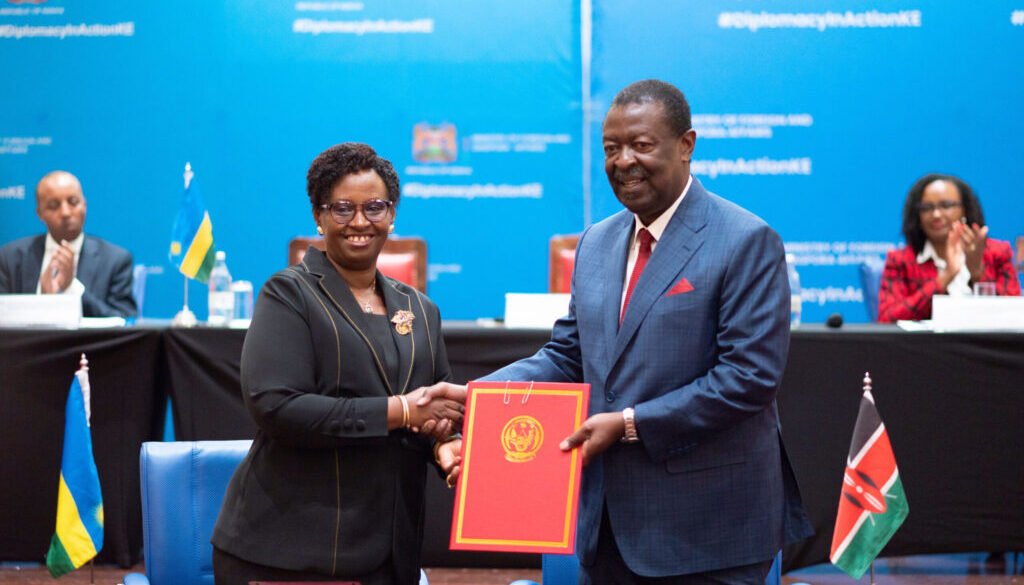
Rwanda’s Minister of State for Foreign Affairs and International Cooperation, Dr. Usta Kaitesi, and Kenya’s Prime Cabinet Secretary and Cabinet Secretary for Foreign and Diaspora Affairs, Dr. Musalia Mudavadi, led their respective delegations.
The two sides signed 11 bilateral instruments, including two agreements and nine memoranda of understanding, covering areas ranging from justice and immigration to water management, local governance, security, culture and conservation.
Earlier, Kenya’s Principal Secretary for Foreign Affairs, Dr. Korir Sing’oei, said the allocation of land at Miritini and Naivasha, together with other connectivity initiatives, provides a foundation for stronger trade and investment between the two countries.
“Our responsibility now is to ensure that these initiatives are fully utilized and that their benefits are increasingly felt by businesses and citizens on both sides,” Sing’oei said.
That emphasis is particularly relevant to the Northern Corridor, where several recent developments are beginning to give the Kenya-Rwanda relationship a more tangible economic dimension.
Building a Corridor Around Rwanda’s Trade
In January, Kenya and Rwanda formalized an arrangement for a Kenya Ports Authority liaison office in Kigali, intended to provide a direct link between Rwandan businesses and Mombasa port services.
Kenya Ports Authority says the Kigali office serves as an interface with both Mombasa and the Naivasha Inland Container Depot, bringing port-related services closer to Rwandan users.
On September 29, Rwanda received its maiden 40,000-tonne cargo of refined petroleum products at Mombasa’s Kipevu Oil Terminal 2, with the arrival of the MT Sea Wolf marking the activation of a new supply route through Kenya’s Northern Corridor.
The shipment came under a framework agreed by Rwanda and Kenya in June, comprising an MoU on petroleum imports through the Northern Corridor and two implementing agreements covering transportation and storage through Kenya’s infrastructure.
Rwanda says the arrangement is intended to strengthen the resilience of its petroleum supply chain and improve energy security.
The developments point to a relationship increasingly organized around a physical economic chain, with cargo arriving at Mombasa, moving through Kenyan logistics infrastructure and eventually reaching Rwanda.
Meanwhile, Rwanda recently acquired a 1.05 percent stake in Kenya Pipeline Company during its IPO, giving it an investment position in an important part of the energy infrastructure serving the corridor.
From Agreements to Economic Architecture
The 11 instruments signed at the JPCC broaden the relationship into areas that will also matter as cross-border activity grows.
They cover mutual legal assistance and the transfer of sentenced persons, immigration, political consultations, housing and urban development, diaspora affairs, water and irrigation, local governance, policing, culture and conservation.
These may appear far removed from the Port of Mombasa, but they form part of the institutional architecture required when people, businesses, capital and goods increasingly move between two countries.
For Kaitesi, the value of the JPCC lies precisely in its ability to turn that political relationship into practical cooperation.
“The JPCC is an important mechanism for translating our political commitments into concrete actions. It provides us with an opportunity to review the status of our relations in various sectors, identify areas where progress can be accelerated, and explore new areas of cooperation,” she said.
That perhaps makes the most revealing development from the Nairobi meeting the emergence of a relationship in which Rwanda is present at multiple points along the route to its international markets.
Mudavadi similarly stressed that the new commitments would require sustained institutional follow-up, with responsibilities and timelines clearly defined.
“Our respective institutions should maintain close engagement, with clear responsibilities, timelines and appropriate follow-up mechanisms to ensure that the decisions and commitments reached are effectively implemented,” he said.
Rwanda High Commissioner Ernest Rwamucyo said the new Northern Corridor petroleum route would strengthen energy security, improve supply-chain efficiency and reduce logistics costs. He urged both countries to examine where existing commitments are being held up and focus on practical solutions.
“We should review how well our existing agreements are being implemented, identify what is holding up progress, and focus on practical solutions that deliver results,” he said.
That emphasis on results now gives fresh meaning to the expanding network of links between the two countries. It’s part of a relationship increasingly built around the movement of goods, capital, people and services.
With this, the Northern Corridor is anticipated to become the physical backbone of a more integrated Kenya-Rwanda economy whose value is measured not only by what Rwanda imports, but by what businesses and investors on both sides are able to build from it.