Burundi Prime Minister sacked
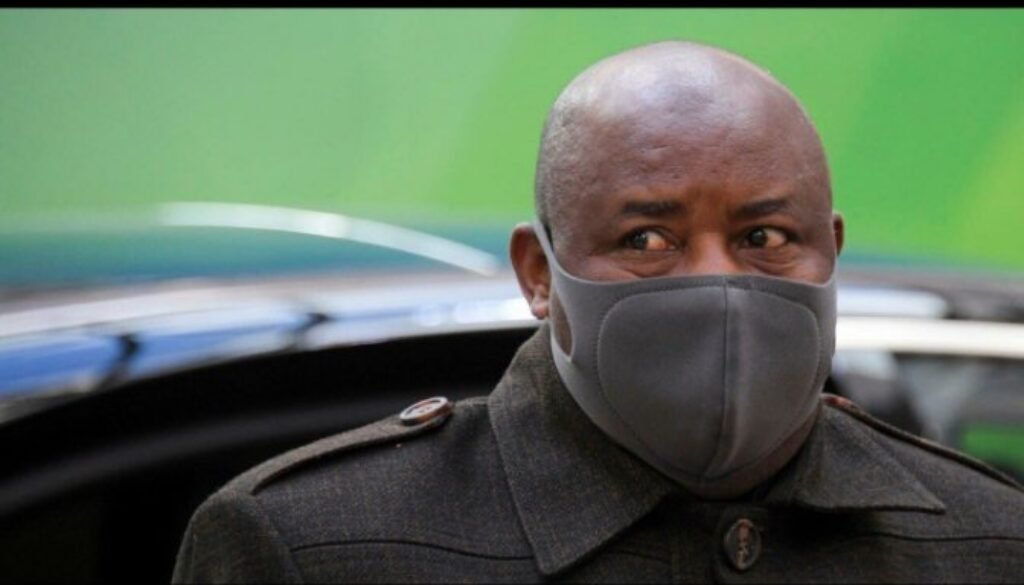
CAPTION: Burundi President Évariste Ndayishimiye recently. (File photo).
By Michael Fitzpatrick
KAMPALA – Security Minister Gervais Ndirakobuca has replaced Alain Guillaume Bunyoni as prime minister after a unanimous vote in parliament, according to the national broadcaster RTNB.
Bunyoni’s departure came after President Ndayishimiye, who has been in power for just over two years, last week warned of a coup plot against him.
“Do you think an army general can be threatened by saying they will make a coup? Who is that person? Whoever it is should come and in the name of God I will defeat him,” Ndayishimiye had warned at a meeting of government officials on Friday.
Ndayishimiye took power in the troubled nation in June 2020 after his predecessor Pierre Nkurunziza died of what the Burundian authorities said was heart failure.
The country was wracked by turmoil in 2015 when then president Nkurunziza launched a bid for a third term in office, despite concerns over the legality of such a move.
New Prime Minister Ndirakobuca was sanctioned in 2015 by the United States for “silencing those opposed” to Nkurunziza’s third term bid.
Burundi’s history is littered with presidential assassinations, coups, ethnic massacres and a long civil war that ended in 2006 and left some 300,000 dead.
President Ndayishimiye was born on 17 June 1968 at Musama, Kabanga Zone in Giheta, Gitega Province in Burundi. He is reported to be a “fervent” Catholic. He began studies in law at the University of Burundi (UB) but was still studying in 1995 when Hutu students were massacred as part of the inter-ethnic violence which accompanied the Burundian Civil War (1993–2005).
He fled and joined the moderate rebel National Council for the Defense of Democracy – Forces for the Defense of Democracy (Conseil National Pour la Défense de la Démocratie – Forces pour la Défense de la Démocratie, CNDD–FDD) which drew its support predominantly from ethnic Hutu. Rising up the ranks of the group during the civil war, he presided over its militia and military activities. He gained the nickname “Neva”. A series of agreements in 2003 paved the way for the CNDD–FDD to enter national politics as a political party.
Ndayishimiye became deputy chief of staff of the Burundian Army. In 2005, the CNDD–FDD came to power under the leadership of Pierre Nkurunziza whose background was similar and who had also fled UB in 1995.
Ndayishimiye served as Minister of the Interior and Public Security from 2006 to 2007 before becoming the personal military aide (chef de cabinet militaire) to Nkurunziza. He held this post until 2014.
Alongside his office, he studied at Wisdom University of Africa and gained a degree in 2014. He also chaired the Burundi National Olympic Committee for much of this period.
After rising opposition, Nkurunziza announced in 2018 that he would not stand for a fourth term as president in 2020. Ndayishimiye was the candidate he endorsed as his replacement in the CNDD–FDD and was considered to be a “close ally”.
It had been reported that Nkurunziza “wanted to run the country from behind the scenes”, using Ndayishimiye as a puppet ruler after his resignation.
However, it was also noted that Ndayishimiye may have been chosen as a compromise between Nkurunziza and other CNDD–FDD “generals” determined to ensure that a Civil War veteran retained control.
Ndayishimiye was “not associated with the worst abuses” under Nkurunziza and was reported to be the most “open” and “honest” candidate within the CNDD–FDD. Ndayishimiye won elections held in May 2020, winning 68 percent of the national vote. However, the fairness of the poll was widely questioned and it occurred in the middle of the COVID-19 pandemic in Burundi.
Nkurunziza died unexpectedly on 8 June 2020. Since Ndayishimiye had already won the elections, the Constitutional Court accelerated his inauguration as president. He was installed at a ceremony in Gitega on 18 June 2020, two months ahead of schedule.