Can a US-backed mineral highway bring peace and prosperity to DR Congo?
As trains carrying thousands of tonnes of copper from the Democratic Republic of Congo roar through her community, 20-year-old Manuela Julia is not thinking about critical minerals or billion-dollar investments.
She is thinking about getting around more easily.
The railway runs through Catumbela, near the Angolan city of Lobito, on the Atlantic coast.
For Julia, it has made travelling cheaper and more convenient.
“Before, I had to use a taxi, which is much more expensive. Now it is cheaper and easier to travel,” she says.
But the railway has ambitions far bigger than improving local transport.
It is part of the Lobito Corridor, a US-backed effort to secure access to Africa’s critical minerals and promote regional economic cooperation, which Washington hopes will help bring peace to conflict-torn eastern DR Congo.
Under agreements brokered by US President Donald Trump, DR Congo and neighbouring Rwanda have committed to greater economic cooperation, including more transparent mineral supply chains and regional infrastructure development.
The wider plan envisages linking these initiatives to the railway, which transports minerals from Central Africa to Western markets via Angola, rather than east to China as most do currently.
The hope is that formalising the mineral trade and encouraging investment could help curb illicit markets that have helped finance armed groups and fuel instability.
Hassan Lali/BBC
Manuela Julia says the railway has made travelling around easier
But can a railway built to move minerals to global markets also deliver peace and prosperity?
The Lobito Corridor links DR Congo’s mineral-rich south to Angola’s Atlantic coast through the Benguela Railway and the Port of Lobito.
Its importance has grown as demand for copper and cobalt rises, driven partly by the global transition to cleaner energy, as both are critical ingredients for all kinds of electrical components.
“The timing matters,” says Johannesburg-based political risk analyst Wellington Muzengeza
“Electrification and the energy transition have increased the strategic importance of copper, cobalt and reliable mineral supply chains.”
DR Congo is the world’s largest producer of cobalt and one of its biggest copper producers, along with neighbouring Zambia. The US sees the corridor as a means to diversify mineral supplies and reduce reliance on China, which dominates much of the world’s processing capacity.
A US-DR Congo strategic partnership identifies the route from the Congolese town of Sakania to Lobito as a priority for mineral exports, while the economic framework agreed by DR Congo and Rwanda envisages connecting regional infrastructure and trade initiatives to the corridor.
The project has attracted over $750m (£570m), including funding backed by the US International Development Finance Corporation and the Development Bank of Southern Africa to upgrade railway tracks, signalling systems and trains.
The railway, built in 1902 under Portuguese colonial rule, was originally designed to transport goods and minerals from Central Africa to the Atlantic coast. After years of disruption during Angola’s civil war, it was rebuilt and fully reopened in 2015.
The US first got involved in the project under former President Joe Biden but backing has continued under Trump.
At Lobito’s mineral terminal, the renewed ambitions are already visible.
When the BBC visited, a train carrying about 12,000 tonnes of copper cathodes from DR Congo had arrived. Workers moved the refined copper sheets into a warehouse before they were loaded on to ships bound for international markets, mostly the US.
The cargo is handled by Lobito Atlantic Railway (LAR), which has a 30-year concession to operate freight services along the corridor and manage the mineral terminal.
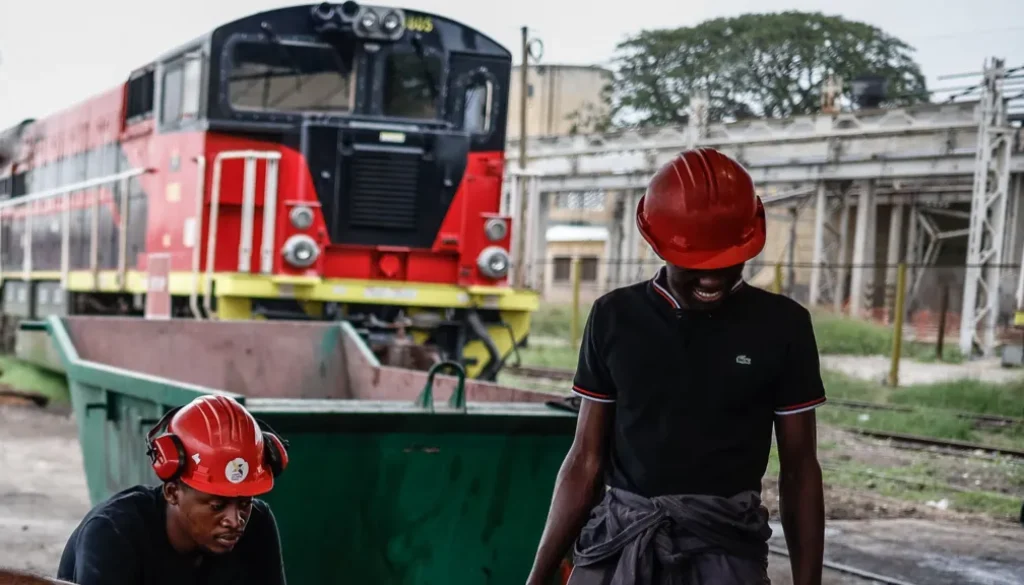
The Lobito Atlantic Railway has a 30-year concession to operate freight services along the corridor
Chief operating officer Nicholas Gregoir says freight volumes have more than doubled since the company took over in January 2024.
LAR expects to transport about 200,000 tonnes of copper through the corridor in 2026.
For mining companies, the railway offers a shorter route to international markets.
“The Lobito Corridor is the shortest route for both Zambia and the DRC,” to the Atlantic, says Kátila Vanessa Monteiro da Silva Neto, executive director of the Lobito Port Authority.
Zambia, Africa’s second-largest copper producer, also plans to connect its Copperbelt to Lobito through a proposed 830km (515 mile)-railway.
But a more efficient route to market does not automatically translate into economic transformation.
“Joining a corridor is not the same as industrialising,” Muzengeza says. “The test is not simply whether Zambia gains another route to the sea. It is whether that route helps build a stronger economy.”
Some Angolans believe the railway’s greatest value could lie in what it offers businesses and communities beyond mining.
“I call it a corridor of development,” says businessman Adérito Areias.
The railway passes through some of Angola’s most productive agricultural regions.
Better transport links could help farmers reach larger markets and reduce losses.
“If there isn’t an artery carrying products from the interior to where there is demand, those products simply rot where they are produced,” Areias says.
But the challenge is turning that ambition into reality.
The Port of Lobito handled about 1.8 million tonnes of cargo in 2025, of which around 158,000 tonnes was minerals. Its mineral terminal can handle up to 3.6 million tonnes annually.
“The port already has the capacity,” says Neto. “What we need now is sufficient railway capacity and rolling stock.”
For residents along the route, the benefits have been immediate.
State-owned railway operator Caminho de Ferro de Benguela (CFB), which runs passenger services, carried a record 1.6 million passengers in 2025.
LAR says it directly employs nearly 1,000 people, 98% of them Angolan.
“This job allows me to support my family,” says Domingos Canhama, a father of four and a forklift operator at CFB.
“I can put food on the table, maintain a home and help support my father,” he says.
Muzengeza argues that the bigger opportunity is developing local businesses in engineering, maintenance, warehousing and agricultural processing.
“Businesses in Angola need access to the railway, not just proximity to it. That means feeder roads, electricity, storage and predictable services,” he says.