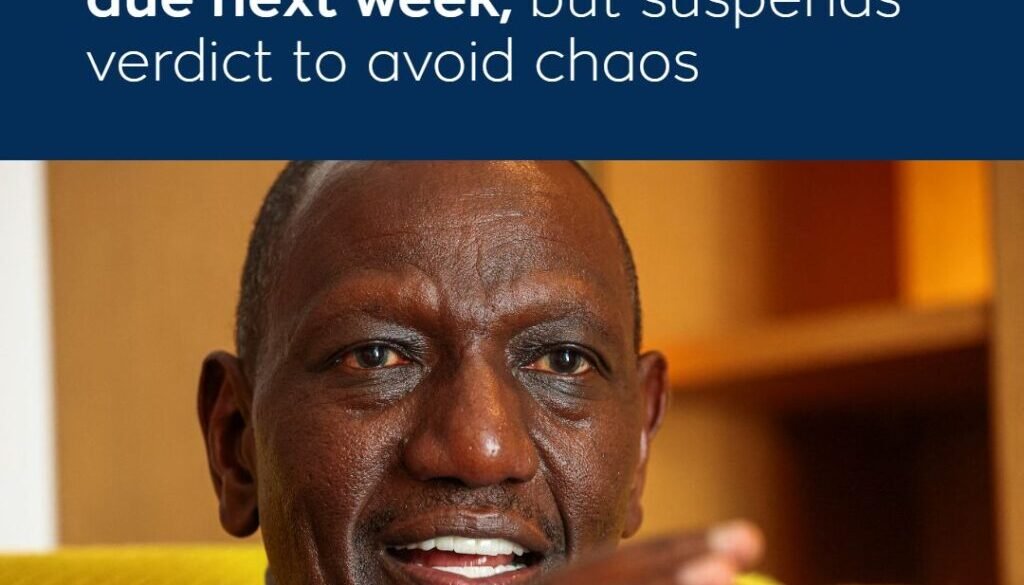
Confusion as Court makes landmark ruling
By James Gichigi
NAIROBI – The High Court has ruled that Kenya’s next General Election ought to be held in August 2026, not the scheduled August 10, 2027.
In a landmark judgment, Justice Mugure Thande held that the fifth year following the August 9, 2022, presidential election commenced on August 9, 2026, meaning the next presidential election should be held within that fifth year as required by the Constitution.
“A declaration is hereby made that the fifth year after the previous presidential election held on 9th August 2022 commences on 9th August 2026,” Justice Thande ruled.
The decision arose from a petition filed by Dr Owiso Owiso, Ashioya Biko and Khelef Khalifa, who challenged the interpretation of constitutional provisions governing the timing of presidential elections and the length of the President’s term.
The petitioners sought a declaration that, under Article 136(2)(a) of the Constitution, the next presidential election should be held in August 2026.
In her judgment, Justice Thande declared that Article 136(2)(a) requires the presidential election to be held on the second Tuesday of August in the fifth year following the previous General Election, and not after the fifth year.
However, the judge suspended the effect of the declaration to avoid disruption and allow parties to pursue appeals.
The petitioners sought declarations on the proper interpretation of Article 136(2)(a) of the Constitution, including an order directing that the next presidential election be held in August 2026.
They argued that the Constitution requires a presidential election to be held on the second Tuesday of August in the fifth year following the previous election.
Applying the method of calculating time under Article 259(5)(c), they submitted that the fifth year after the August 9, 2022 election began on August 9, 2026, making August 11, 2026—the second Tuesday of that month the constitutionally prescribed election date.
The petitioners further argued that the IEBC had adopted a similar interpretation in scheduling the 2013 and 2017 General Elections.
They maintained that the Constitution does not guarantee the President a fixed five-year term and that the timing of elections must be guided by the Constitution rather than the duration of the President’s tenure.
The Independent Electoral and Boundaries Commission (IEBC) opposed the petition, arguing that the interpretation would create an absurd constitutional outcome by shortening the terms of elected leaders.
It cited Article 177(4), which guarantees Members of County Assemblies a five-year term, and argued that bringing forward the General Election by nearly a year would conflict with other constitutional provisions.
The Commission also argued that the Constitution envisages all six elective positions being contested on the same day under a predictable electoral calendar, saying simultaneous elections promote coherence, efficiency and stability in governance.
Justice Thande, however, rejected the respondents’ arguments, holding that the constitutional provisions governing elections must be read together as an integrated whole because they tie the elections of the President, Members of Parliament, governors and Members of County Assemblies to the same electoral cycle.
The court declared that, under Article 136(2)(a), the presidential election must be held on the second Tuesday of August in the fifth year following the previous General Election, not after the fifth year.
“The correct interpretation of Article 136(2)(a) of the Constitution is that the second Tuesday in the fifth year with regard to the next presidential election must mean 11th August 2026,” Justice Thande ruled.
The judge further held that the election date is fixed by the Constitution and is not subject to the discretion of the IEBC.
The court noted that the IEBC’s Election Operation Plan 2025–2027 had scheduled the next General Election for August 10, 2027, but found that date falls after, rather than within, the fifth year envisaged by the Constitution.
Consequently, the court declared that holding the next presidential election on any date other than August 11, 2026, would contravene the Constitution.
However, Justice Thande suspended the declaration until after the next General Election, saying immediate implementation would be impractical given that the IEBC, prospective candidates and the public had all been preparing for an August 2027 poll.
“To grant the order as sought will be to grant an order that is logistically impossible to implement, given that the 2nd Respondent, prospective candidates for elective posts and Kenyans in general are all geared towards an election in August 2027,” the judge observed.
The court also declared that the President’s tenure is not constitutionally fixed at five years, finding that neither Article 142 nor any other provision expressly guarantees a five-year presidential term.
For us to service you better, please leave a comment after reading the story and in case you have a community story you like us to publish reach us on +256752440223 or email: wanderaouma@gmail.com