Court blocks US Ebola centre in Kenya
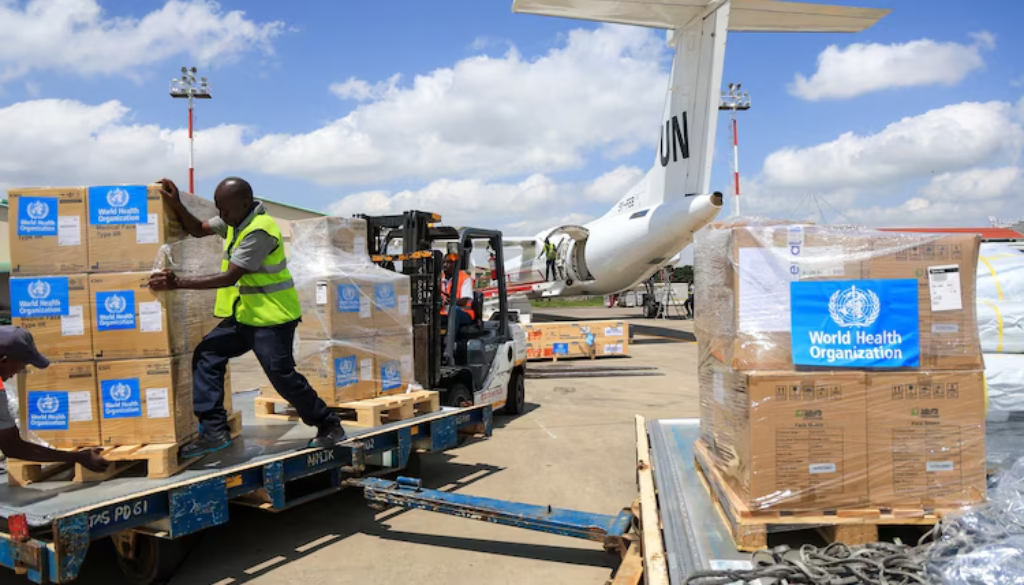
CAPTION: Workers load World Health Organization (WHO) emergency supplies onto a United Nations plane in Nairobi, Kenya, Wednesday, May 20, 2026headed for Congo to combat the Ebola outbreak in Ituri province.
By Agencies
NAIROBI – The plan seemed simple enough, at least from Washington’s perspective. The US would set up a 50-bed quarantine facility on Kenya’s Laikipia Airbase, about 200 kilometers north of Nairobi, where Americans exposed to the Ebola outbreak in the Democratic Republic of Congo could be held and monitored.
Secretary of State Marco Rubio called President William Ruto, the US committed US$135 million (KES 1.74 billion), and senior Trump administration officials told the press Kenya had given written approval. It was by all metrics a done deal.
Kenyans, however, had other ideas.
Within hours of the plan becoming public, the main doctors’ union, the Law Society of Kenya, and civil society groups were already at the courthouse.
By Thursday May 28th, 2026 afternoon, the Katiba Institute had filed a petition at the Milimani High Court, and Justice P.M. Nyaundi issued conservatory orders blocking the government from establishing or running any such facility. The matter returns to court on June 2.
To no one’s surprise, the reaction on the ground was fast and furious. Ordinary Kenyans expressed alarm about the prospect of Ebola patients being flown into the country, with people who work in crowded, high-contact jobs particularly worried about what it would mean for their daily safety.
The Kenya Medical Practitioners, Pharmacists and Dentists Union, which represents more than 10,000 doctors across public and private hospitals, accused the government of conducting backdoor negotiations without any transparency or public participation.
They threatened a nationwide strike if the deal proceeded and described the arrangement as Kenya being treated as a containment colony for a disease it had nothing to do with generating. The union also issued a 48-hour strike notice.
The question that spread widely online was a simple one of logic: if a 12-hour medevac flight back to the US is too dangerous for exposed Americans, how exactly is flying those same people into Kenyan airspace and placing them in Laikipia any safer? And why Kenya, when the epicenter of the outbreak is in Congo, a country that was apparently not considered for a similar arrangement?
There was also context that made Kenyans angrier. The two governments had recently renegotiated health aid funding, with Kenya set to receive 21% less in US global health support over the next 5 years, a reduction of roughly $423 million compared to previous levels.
The same government cutting Kenya’s health budget now wanted to use Kenyan soil to house its own sick citizens.
Criticism also came from inside the US. CDC officials strongly recommended against the plan, with the agency’s acting director reportedly advising against it as well, and some officers at the agency said it would make recruiting and staffing for Ebola response activities significantly harder.
The Katiba Institute’s petition went beyond just stopping the facility. It asked the court to compel the Ministry of Health CS to publish any agreements related to the facility, along with environmental and biosafety assessments, and to clarify what parliamentary oversight, if any, had been involved.
Going by the constitution, the executive cannot expose the public to significant risk without following due process, and doing this quietly, without public participation, is exactly what the constitution was written to prevent.
The court agreed it was urgent and blocked the facility pending a full hearing.
As of now, the 50-bed unit at Laikipia sits in limbo. No patients had been assigned to it, though US Public Health Service personnel were reportedly already in training at Joint Base Andrews in Maryland ahead of a deployment that may not happen on its original timeline.
The broader Ebola situation remains serious. The outbreak is driven by the Bundibugyo strain, a rare form for which there is no approved vaccine or treatment.
DRC has confirmed over 1,000 suspected cases and at least 220 deaths since declaring an outbreak on May 15, and the WHO believes the true scale is considerably larger. The virus has also crossed into Uganda.
Kenya has no confirmed cases.