EAC environmental threat red flag raised
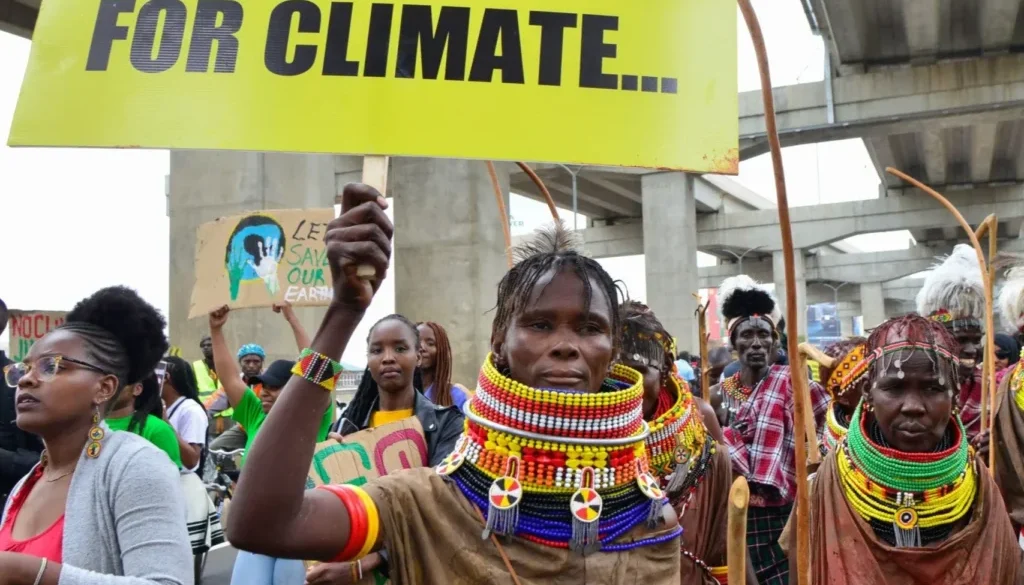
CAPTION: Some of the members of the minority and indigenous communities in East Africa out side a conference in Nairobi on Wednesday August 19th, 2026. (Courtesy photo).
By Our reporter
NAIROBI – Climate change is an existential threat to minority and indigenous communities in East Africa. According to East Africa Indigenous people’s reports, these communities are disproportionately, facing persistent famines, floods, invasive species, crop and pasture degradation and human and wildlife conflict.
The report was compiled by researchers led by Roland Ebole, a Nairobi based philanthropic strategist and researcher with 18 years of experience at the intersection of conservation land governance, natural resource management, and human rights across East
Africa. His work spans Kenya, Tanzania, Uganda, Rwanda, Ethiopia and Sudan, with a strong record of leading high stakes investigations, facilitating community consultations and engaging government institutions, indigenous peoples, civil society and private sector.
“This regional comparative briefing draws together findings from research focusing on Kenya, Tanzania and Uganda looking at selected minority and indigenous communities living these realities,” reads the report released on Wednesday August 19th, 2026.
Adding, “To these communities, climate change remains unrecognized fully as a structural driver of environmental stress, revealing persistent gaps in public awareness, policy framing, and civic engagement. Environmental degradation, political marginalization, weak institutional safeguards and socio‑cultural dynamics intersect to heighten risks for minority and indigenous environmental defenders while constraining meaningful participation of their communities in climate governance.”
The research was conducted between August 2024 and February 2025 across the three countries and uncovers a deeply entrenched pattern in which extreme climate
vulnerability and rapidly limiting civic space form mutually reinforcing crises.
The research was commissioned under the programme: Researching Green Activism: How to
Better Protect Communities, Civil Society Organizations, Networks, and Climate Change Defenders in East Africa.
The programme was implemented by Minority Rights Group (MRG) in collaboration with Isiolo Gender Watch in Kenya, the Legal and Human Rights Centre (LHRC) in Tanzania
and Resource Rights Africa (RRA) and Buliisa Initiative for Rural Development Organisation (BIRUDO) in Uganda.
In the methodology, “the researchers conducted more than 1,100 household surveys, focus group discussions, key informant interviews and community dialogues across six highly fragile decentralized areas in the three countries, including Isiolo and Marsabit counties in Kenya; Kiteto and Hanang districts in the Manyara region of Tanzania; and Buliisa and Moroto districts in Uganda.”
The fundamental finding emerging from this transnational analysis is that environmental human rights defenders from minority and indigenous groups operate in unsafe environments. They are at the same time on the frontlines of climate changes and mismanagement of climate response by state and non‑state actors, and targets of reprisals from state, private companies, political actors and even members of their communities, especially elite community actors.
It reads, “Countries in East Africa are also undertaking largescale infrastructure development with investments from multinationals and other development partners. Extractive projects and top‑down conservation models under national development agendas like Vision 2030 of Kenya, commercial agrarian expansion in Tanzania and the East African Crude Oil Pipeline of Uganda have led to involuntary removal of individuals or communities from
their homes or land, often violating their human rights and legal protections. In those instances, communal lands are compulsorily acquired by states and their agents through forcible and militarized means without adequate legal protection, including free, prior and informed consent (FPIC), notice, or alternative accommodation, leaving many destitute.”
The report says environmental human rights defenders who document environmental harms, demand transparency, or challenge the exclusion of indigenous knowledge systems in ecological governance are often labelled as anti-‑development or anti‑government.
“In extreme cases, states have targeted them for trumped‑up charges of terrorism.
Such reprisals create a dangerous landscape marked by systematic intimidation, arbitrary arrest and detention, physical assault, digital surveillance, smear campaigns and gender‑based violence (GBV),” it reads.
“This comparative briefing provides cross‑ regional findings and structural, actionable policy
recommendations. These recommendations target national judiciaries, county and district authorities, security agencies, civil society coalitions, international development partners and regional and international mechanisms,” further reads.
“The ultimate objective of the programme from which this research stems is ‘to create an enabling environment for climate change defenders from ethnic minorities and indigenous peoples to play their role in pushing for responsive climate actions, holding governments accountable and protecting communities adversely affected by climate change impacts in Kenya, Tanzania and Uganda,’” says the report.
“That enabling environment for environmental human rights defenders can only happen
when stakeholders dismantle the culture of silence and intersectional justice and the endorsement of traditional indigenous knowledge on environmental conservation,” concludes.