How corruption drains Kenya’s finances, World Bank
CAPTION: Qimiao Fan presents at a past event. PHOTO/@WorldBankKenya/X
By Kenneth Mwenda
NAIROBI – The World Bank has warned that corruption and collusion are worsening Kenya’s public finances, estimating that the practices widen the country’s fiscal deficit by approximately two percentage points of Gross Domestic Product (GDP).
Qimiao Fan, the World Bank Division Director for Kenya, Rwanda, Somalia and Uganda, said weak governance was among the fundamental constraints holding back Kenya’s economic growth and job creation.
Speaking on Wednesday, November 4, 2026, during the launch of the 34th edition of the Kenya Economic Update, Fan said corruption was increasing the cost of government operations and limiting resources available for development.
“With corruption and collusion in this report, we estimate that corruption and collusion actually widens fiscal deficit by about two percentage points of GDP,” Fan said.
The report, which focuses on governance constraints to economic growth and job creation, identifies corruption as a major economic challenge, with consequences extending beyond public finances.
Fan explained that weak governance also raises the cost of essential services, including electricity and logistics, making it more expensive for businesses and households to operate.
According to the World Bank official, these costs are estimated to be more than double those recorded in countries in other parts of the world.
He further noted that corruption was affecting businesses, particularly medium-sized firms with the potential to expand and employ more people.
” In the surveys of companies, 39 per cent of firms identifying corruption as a major constraint,” Fan said.
Kenya’s rising debt burden
The warning comes as Kenya continues to grapple with a widening budget deficit, high public debt and rising interest payments.
Fan said Kenya’s fiscal deficit reached 6.8 per cent of GDP in the last financial year, against a target of 4.7 per cent, largely because of higher government spending and lower-than-expected revenue collection.
He attributed some of the additional expenditure to supplementary budgets, which increased pressure on public finances.
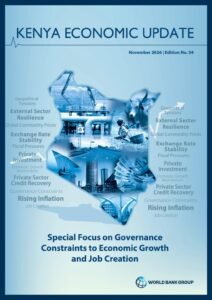
Public debt had also reached approximately 70 per cent of GDP by the middle of 2026, with interest payments consuming about one-third of government revenue.
Nairobi’s skyline. PHOTO/@WorldBankKenya/X
This leaves the government with fewer resources to finance essential public services and development priorities.
Beyond the fiscal challenges, Fan warned that the quality of employment remained a major concern despite growth in the number of jobs.
He said nearly 84 per cent of jobs in Kenya were informal, often characterised by lower wages, limited worker protection and low productivity.
The World Bank director noted that close to one million young people enter Kenya’s labour market every year, yet the economy creates an average of only 120,000 to 150,000 formal-sector jobs annually.
He argued that Kenya needed to focus not only on managing fiscal pressures but also on creating more productive and better-paying employment opportunities.
Economic gains from fighting corruption
Fan said addressing governance weaknesses could deliver substantial economic benefits, including higher GDP, more jobs and a reduction in public debt.
According to the report’s modelling, moderate governance reforms could raise Kenya’s GDP by nearly 9 per cent relative to the current economic path, while more ambitious reforms could increase it by more than 20 per cent compared with a scenario without reforms.
Ambitious reforms could also support the creation of approximately 7.7 million additional and better-quality jobs while helping to reduce public debt as a share of GDP by 2035.
Fan said the potential benefits of improving governance extended beyond strengthening public institutions, directly affecting economic growth, employment, government finances and household living standards.