Latest Rwanda’s governance report released
By Alice Umutesi
KIGALI – The government recorded improvements in four of its eight governance pillars, while the other four declined, with quality-of-service delivery registering the biggest drop, according to the latest Rwanda Governance Scorecard (RGS).
Released by the Rwanda Governance Board (RGB) on Thursday, October 22, the 13th edition of the scorecard shows that quality of service delivery declined by 3.25 percentage points, from 71.73 per cent in 2025 to 68.48 per cent in 2026.
The decline was largely attributed to weaker performance in digital public services. Citizen satisfaction with online court case filing fell by 13.6 percentage points, while satisfaction with radio communication and Irembo services dropped by 7.5 and 5.6 percentage points, respectively.
Meanwhile, investing in human and social development recorded the biggest improvement, rising by 3.86 percentage points, from 64.69 per cent to 68.55 per cent. The gains were driven by improvements in climate change and environmental resilience, education and health.
“These are the gains that we should recognise because they reflect years of deliberate institution-building and a lasting commitment to accountability, citizen participation, the rule of law, security, transparency and a culture of performance,” said Dominique Habimana, Minister of Local Government.
The scorecard assesses governance performance across eight pillars, 35 indicators and 153 variables, up from 151 variables in the 12th edition released in 2025.
Five pillars score above 80 per cent
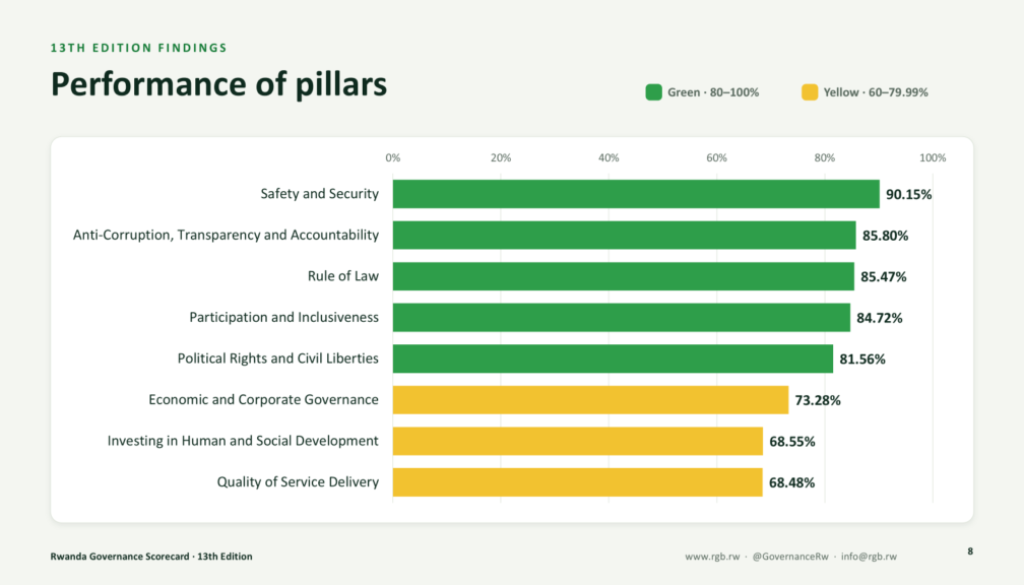
Five of the eight governance pillars scored above 80 per cent, with safety and security maintaining the highest score at 90.15 per cent.
It was followed by anti-corruption, transparency and accountability at 85.80 per cent, rule of law at 85.47 per cent, participation and inclusiveness at 84.72 per cent, and political rights and civil liberties at 81.56 per cent.
Compared with 2025, rule of law recorded the biggest improvement among these five pillars, rising by 3.84 percentage points, from 81.63 per cent to 85.47 per cent.
Anti-corruption, transparency and accountability also improved, rising from 84.67 per cent to 85.80 per cent, an increase of 1.13 percentage points.
However, political rights and civil liberties declined by 1.15 percentage points, from 82.71 per cent to 81.56 per cent, while participation and inclusiveness fell by 1.59 percentage points, from 86.31 per cent to 84.72 per cent.
Economic and corporate governance also dropped by 1.56 percentage points, from 74.84 per cent to 73.28 per cent.
Habimana cautioned that the strong performance in some pillars should not overshadow areas where progress remains limited.
“We cannot be satisfied where service delivery is declining and human and social development remains low. As we sustain our stronger pillars, we must act faster and more deliberately where performance is still weak.”
Participation and decentralisation
Within the participation and inclusiveness pillar, power-sharing and inclusiveness scored 100 per cent, while gender equality in leadership and decentralisation scored 79.26 per cent and 70.34 per cent, respectively.
Under the safety and security pillar, resilience, social cohesion and unity recorded the highest score at 95.87 per cent, followed by maintaining security at 92.58 per cent.
Personal and property safety registered the lowest score within the pillar, at 83.46 per cent.
Habimana said governance performance should ultimately be assessed by how policies and institutions affect citizens’ daily lives, particularly at the local level.
He added that the findings should guide local governments in strengthening coordination, deepening citizen participation and ensuring that public services are accessible, timely, equitable and responsive to citizens’ needs.
Human development and economic performance
Within the human and social development pillar, health recorded the highest score at 78.22 per cent, followed by education at 73.05 per cent and social protection at 67.15 per cent.
Climate change and environmental resilience scored 64.89 per cent, while a secure and prosperous family registered the lowest score at 59.45 per cent.
Despite recording the biggest improvement, human and social development remained the lowest-scoring of the eight governance pillars, at 68.55 per cent.
In economic and corporate governance, business environment promotion recorded the highest score at 84.79 per cent, while corporate governance had the lowest score within the pillar, at 60.20 per cent.
The scorecard also assessed macroeconomic performance, including inflation, which scored 28.57 per cent. The figure reflects performance against the scorecard’s assessment criteria rather than the actual inflation rate.
“The real strength of the scorecard lies in continuous self-assessment. It is not just a periodic report. It is a governance instrument that has always helped us to measure, to reflect, to learn and to act,” Habimana said.
He urged public institutions, particularly local governments, to use the findings to inform planning, budgeting, performance contracts and reforms aimed at improving governance and service delivery.