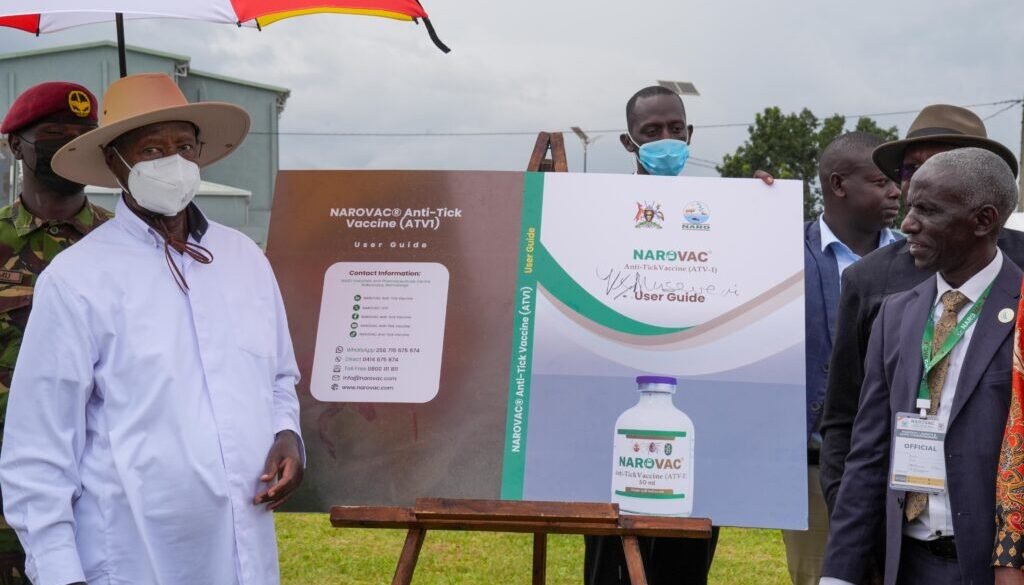
Museveni launches Uganda’s first anti-tick vaccine
CAPTION: President Yoweri Kaguta Museven, left, Executive Director of the National Drug Authority (NDA), Dr. David Nahamya, right, commissioned anti-tick vaccine at the National Livestock Resources Research Institute (NaLIRRI) in Namulonge, Nansana Thursday April 3oth, 2026. (PPU photo).
By Stephen Wandera Ouma
NAMULONGE – President Yoweri Kaguta Museveni has commissioned Uganda’s first locally developed anti-tick vaccine at the National Livestock Resources Research Institute (NaLIRRI) in Namulonge, Nansana
Municipality, describing it as a lasting solution to tick-borne diseases that have long affected livestock.
The Shs170 billion initiative has been funded by the government of Uganda to address the tick threat to livestock in the country.
Speaking at the launch of the vaccine and a production plant on Thursday 30th 2026, the President said ticks have been a major challenge in cattle-keeping areas such as Sheema, Kajara and parts of Kashari, where farmers, despite the absence of tsetse flies, continue to suffer heavy losses.
He described ticks as a long-standing setback to Uganda’s livestock sector and emphasized that the new vaccine provides a safer and more durable alternative to acaricides, which he noted are toxic and become less effective over time.
“The cow now kills the tick,” he said, underscoring the innovation behind the vaccine.
President Museveni also reiterated his commitment to strengthening Uganda’s science sector, proposing tax incentives for scientists similar to those extended to security personnel, in recognition of their role in national development.
CAPTION: President Museveni being showed the production line. (PPU Photo).
He further congratulated the scientists behind the innovation and pledged continued government support.
President Museveni also confirmed government’s commitment to avail the Shs600 billion requested for by the National Agricultural Research Organisation (NARO) to establish the vaccine research hub.
The Minister of Agriculture, Animal Industry and Fisheries, Hon. Frank Tumwebaze, welcomed the milestone, revealing that the project dates back to 2022 when scientists first presented their proposal.
He commended the President and government for the support that has culminated in the successful development of the vaccine.
The State Minister for Animal Industry, Hon. Bright Rwamirama, praised sustained government investment in livestock, noting growth in dairy farming and an increase in livestock numbers.

CAPTION: President Yoweri Museveni, left, flanked Minister of Agriculture, Animal Industry, Frank Tumwebaze, 2nd left, flag off the first consignment to the market in Namulonge. (PPU photo).
The Director General of NARO, Dr. Yonah Baguma, described the launch as both a scientific and economic milestone. He said the vaccine is expected to protect Uganda’s estimated 16 million cattle while reducing reliance on imported vaccines and acaricides.
He added that the facility has the capacity to produce up to 36 million doses annually, with current production at about 3 million doses per month.
So far, 1.5 million doses have been produced, with demand already emerging from neighboring countries.
Dr. Baguma noted that the project has created hundreds of jobs and positions Uganda as a potential regional hub for veterinary vaccine production.
The vaccine, branded NAROVAC-ATV1, is a recombinant product developed using antigens (Subolesin) derived from local tick species. It is administered to cattle from one month old, with three initial doses given at day 0, day 30 and day 180, providing protection for a full year. Booster doses are administered in subsequent years.
The Executive Director of the National Drug Authority (NDA), Dr. David Nahamya confirmed that the manufacturing plant meets required standards, noting that the authority provided technical oversight throughout the development process.
Farmers involved in early trials have reported positive results, citing reduced tick infestations and lower treatment costs. The vaccine is expected to retail at about Shs10,000, making it an affordable option for farmers.
The breakthrough is expected to significantly reduce the cost of tick control, cut reliance on acaricides and boost productivity in Uganda’s livestock sector.



May 3, 2026 @ 6:25 pm
This gave me a whole new perspective. Thanks for opening my eyes.
May 3, 2026 @ 8:26 pm
Thanks for sharing your knowledge. This added a lot of value to my day.
May 3, 2026 @ 10:28 pm
This post cleared up so many questions for me.
May 4, 2026 @ 12:28 am
You really know how to connect with your readers.
May 4, 2026 @ 2:28 am
Thanks for taking the time to break this down step-by-step.