Museveni, Suluhu direct faster action on oil & SGR
By Our reporter
ENTEBBE – Presidents Yoweri Museveni and Samia Suluhu Hassan have directed officials in their respective governments to speed up work on the Tanga energy hub. The agreement to develop the hub was signed in Dar es Salaam on August 6, 2026. Meeting in Entebbe during Suluhu’s two-day state visit to Uganda, the presidents also called for a joint trade committee to address non-tariff barriers facing Ugandan and Tanzanian traders.
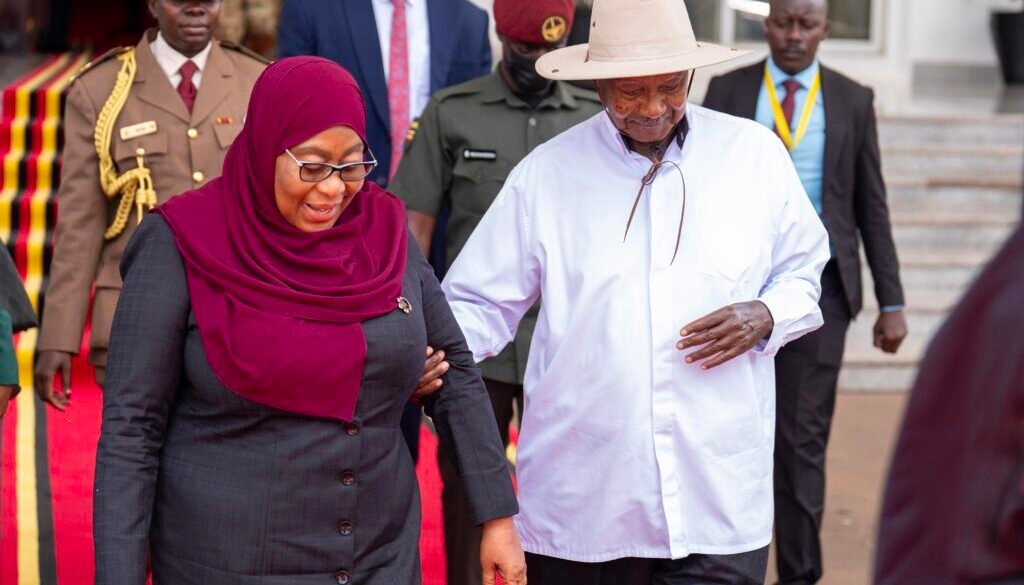
Ugandan President Yoweri Museveni (right) meets Tanzanian President Samia Suluhu Hassan at State House, Entebbe, on November 18, 2026, during her two-day state visit to Uganda. The presidents directed officials in both countries to fast-track the proposed Tanga energy hub, which would refine crude oil and supply fuel across East Africa. They also called for a joint trade committee to tackle non-tariff barriers.
President Yoweri Museveni and his Tanzanian counterpart, Samia Suluhu Hassan, have directed officials in their respective governments to speed up work on an agreement to develop Tanga into a regional hub for oil refining, storage and trade.
They also called for faster preparation of a cross-border standard gauge railway that would give Ugandan traders better access to the port of Dar es Salaam.
The two presidents met at State House, Entebbe, on Wednesday, November 18, 2026, at the start of Suluhu’s two-day state visit to Uganda.
Uganda’s Presidential Press Unit reported that the East African Crude Oil Pipeline (EACOP) project was 93.9% complete, and the presidents called for faster progress on the remaining construction, testing, commissioning and preparations to bring the pipeline into service.
Crude from Uganda’s Tilenga and Kingfisher oilfields will enter the export pipeline at Kabaale in Hoima District and travel to the Chongoleani marine terminal near Tanga, where it will be loaded onto tankers. EACOP Ltd put overall project progress at about 92% on September 2, when Uganda named its crude blend Pearl Sweet.
Hoima and Tanga in the refinery plan
With the pipeline nearing completion, attention at the joint press briefing turned to what happens to the crude once it reaches the coast. Museveni said Uganda intended to build its own refinery in Hoima and supported a larger one at Tanga.
He argued that if each country planned its refineries, storage facilities and distribution networks in isolation, both risked paying for infrastructure they could share, and described the failure to pursue joint investment as a “crippling mistake”.
To close that gap, the presidents directed officials to act on an August 6, 2026 memorandum of understanding to develop Tanga into a regional energy hub.
The Uganda National Oil Company, the Tanzania Petroleum Development Corporation and Vitol Bahrain E.C. signed the agreement in Dar es Salaam.
At the signing, Uganda’s Energy Minister, Dr Monica Musenero, said the planned Hoima refinery would have capacity to process 60,000 barrels a day and would complement the Tanga project.
The proposed hub would give companies a base to refine, store, trade and distribute petroleum products, and the two governments also see scope for joint ventures to manufacture fertilisers, plastics and industrial chemicals.
At the August signing, Deogratius Ndejembi, then Tanzania’s energy minister and now its vice president, estimated that the hub could attract more than US$20 billion in investment. However, the November 18 statement gave no figure for funds committed to the hub.
Beyond the refinery, Museveni and Suluhu also called for faster work on proposed pipelines for natural gas and refined petroleum products. Ndejembi said in August that the proposed refined products pipeline would allow fuel to flow in either direction according to demand.
On electricity, the presidents urged officials to advance the proposed 400-kilovolt interconnector. The planned line runs from Wobulenzi through Masaka to the border at Mutukula and connects to the Ibadakuli substation in Tanzania’s Shinyanga Region, according to the two countries’ transmission project documents.
Railway studies and financing come next
The energy talks were matched by a push on transport links. Uganda and Tanzania signed the framework agreement for the railway in March at the fifth session of the Uganda–Tanzania Joint Permanent Commission in Dar es Salaam.
The proposed line would run from Isaka through Lusahunga in Tanzania, cross from Murongo into Uganda at Kikagati, and extend to Mpondwe in western Uganda. Uganda’s High Commission in Dar es Salaam said the line would strengthen Uganda’s connection to the port of Dar es Salaam.
In Entebbe, the presidents directed their transport ministries and railway authorities to speed up feasibility studies, technical designs and financing arrangements. The governments expect the line to lower the cost of moving goods across the border.
Water transport featured alongside rail. Suluhu outlined plans for the MV New Mwanza to serve Uganda’s Port Bell from Mwanza on Lake Victoria. Tanzania’s Ministry of Transport gives the vessel’s capacity as 1,200 passengers and 400 tonnes of cargo.
The two leaders backed plans to upgrade Port Bell and improve its rail connection to Kampala so that the port can handle more freight. Suluhu said Tanzania was also modernising its ports at Dar es Salaam and Tanga.
Rice and textiles bring trade barriers into focus
Alongside these infrastructure plans, the presidents addressed the obstacles traders face at the border.
In their joint communiqué, they said persistent non-tariff barriers were raising the cost of doing business. They called for a Tanzania–Uganda Joint Trade Committee and directed their ministries to use existing bilateral and East African Community mechanisms to resolve outstanding disputes.
Museveni cited Tanzanian rice as a case in point. He said he had rejected calls to block imports because the rice was cheaper and of better quality, and warned that restrictions on Tanzanian farmers could invite similar action against Ugandan exporters.
On textiles, he sought Tanzania’s support in addressing imports of second-hand clothes, known as mivumba, which he said were undermining local manufacturers.
Suluhu said Tanzania planned to give East African Community affairs a ministry of its own by separating the portfolio from foreign affairs. She urged both governments to follow through on agreements already signed.