Ramaphosa presses Kiir over peace deal
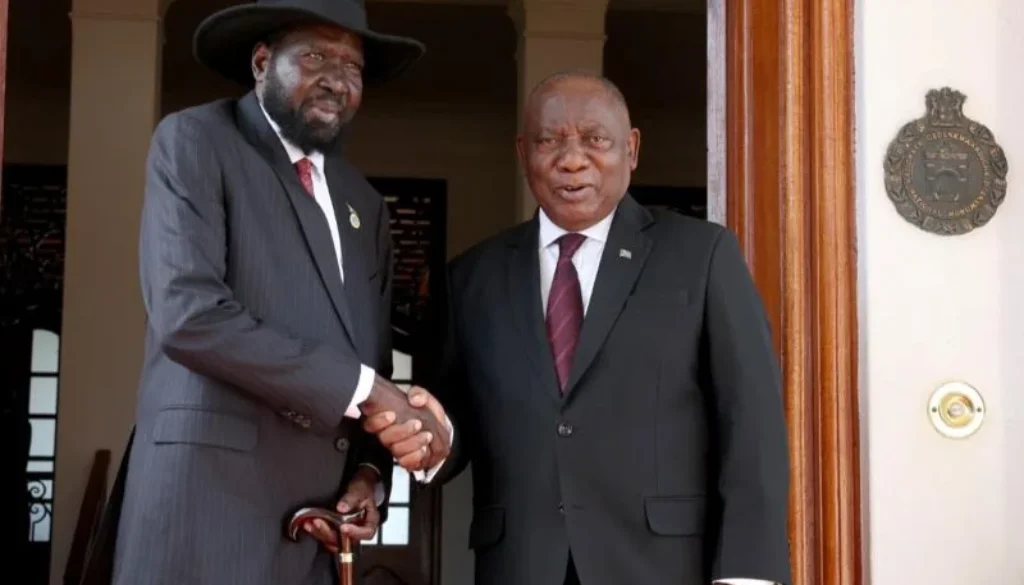
CAPTION: South African President Cyril Ramaphosa engages South Sudanese president Salva Kiir in Pretoria on Wednesday. (South African presidency photo)
South African President Cyril Ramaphosa has urged South Sudanese President Salva Kiir to uphold and fully implement the 2018 peace agreement as the country prepares for its first elections ever, scheduled for December.
The two leaders met in Pretoria on Wednesday to assess progress in the talks, which have intensified ahead of the vote.
Ramaphosa, who chairs the African Union’s Committee of Five on South Sudan, stressed the importance of adhering to the Revitalised Agreement on the Resolution of the Conflict in South Sudan—the deal that ended the worst of the civil war in 2018.
The South African presidency said Ramaphosa, who recently hosted a virtual meeting with the C-5 countries, emphasised that an inclusive electoral process built on trust and cooperation among South Sudanese political stakeholders is needed to address outstanding challenges and support the implementation of the peace agreement.
Kiir’s visit to Pretoria came days after he travelled to Nairobi for talks with President William Ruto on the same issue.
The shuttle diplomacy reflects growing regional concern that South Sudan is not ready for the December polls—and that proceeding without adequate preparation could reignite conflict.
C-5 and the regional push
The C-5 comprises South Africa, Algeria, Chad, Nigeria, and Rwanda. It was established by the African Union to support South Sudan’s peace process and accompany the transitional government toward credible elections.
Its engagement has intensified in recent weeks, with the virtual meeting hosted by Ramaphosa and now the in-person talks in Pretoria.
The message from the region is consistent: the December elections must be peaceful, credible, and inclusive. But the obstacles are formidable.
South Sudan has not held a national election since independence in 2011. Its first polls, scheduled for 2015, were abandoned when civil war broke out in 2013. Elections have been postponed five times since.
The transitional government, established under the 2018 agreement, has been dissolved. President Kiir has removed all five vice presidents, including his long-time rival Riek Machar, and assumed sole executive authority in a caretaker administration.
The country has no voter register. Its electoral commission is underfunded, and its leadership was replaced weeks ago.
More than 2.5 million people remain internally displaced. And the UN Commission on Human Rights in South Sudan reported in September that the country lacked “many of the safeguards and conditions for peaceful and credible polls.”
Ramaphosa’s message to Kiir is not an isolated appeal. It reflects a regional consensus that South Sudan’s transition cannot be allowed to fail.
The war that ended in 2018 killed nearly 400,000 people and destabilised the entire region. A return to conflict would be catastrophic, not just for South Sudan, but for its neighbours, who host millions of South Sudanese refugees and whose economies are intertwined with Juba’s.
The C-5’s engagement is part of a broader AU effort that includes the Panel of Facilitators, the AU High-Level Ad Hoc Committee, and the regional bloc IGAD.