Rwanda secures €40 million EU fund
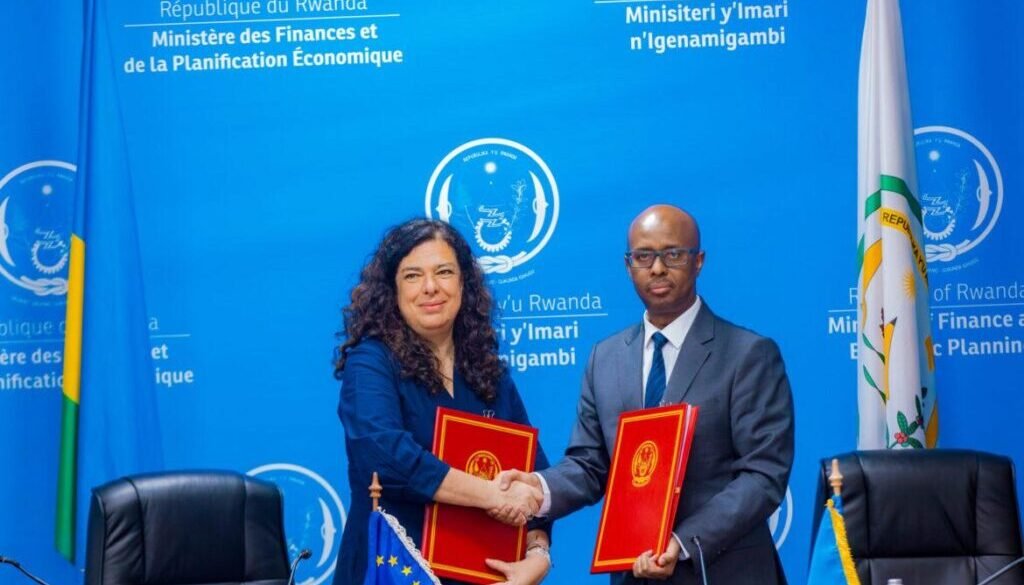
CAPTION: European Union, Ambassador to Rwanda Belén Calvo Uyarra, left, exchange the contract agreement with Rwanda’s Minister of Finance and Economic Planning, Yusuf Murangwa, right, after signing in Kigali Rwanda August 5th, 2026. (Courtesy photo).
By Alex Ngarambe
KIGALI – Rwanda has secured €40 million ($46.8 million) in financing from the European Union to speed up modernisation of its agriculture sector, with a focus on climate resilience and inclusive growth.
The five-year programme, dubbed HANGARIBIHE: Transformational Climate-Smart and Inclusive Agriculture in Rwanda, was signed by the Ministry of Finance and Economic Planning (MINECOFIN) and the EU. It will provide €36 million ($42.1 million) in budget support and an additional €4 million ($4.7 million) for technical assistance, capacity building and studies.
The programme is part of the Team Europe Initiative on “Investing in Sustainable and Inclusive Agricultural Transformation”, bringing together the European Union and partners.
According to the two parties, the support will contribute to the implementation of Rwanda’s National Strategy for Transformation (NST-2), the Fifth Strategic Plan for Agriculture Transformation (PSTA-5), and environment sector priorities.
It will focus on increasing investment in agriculture, expanding irrigation and sustainable land management practices, strengthening climate resilience, restoring degraded ecosystems, and improving climate information systems to support evidence-based decision-making.
Speaking at the signing ceremony, Minister Yusuf Murangwa, Minister of Finance and Economic Planning, said: “This signed financing agreement is a strategic partnership for Rwanda’s agricultural transformation. It will build a modern, productive and climate-resilient sector by driving inclusive productivity gains for smallholders, cooperatives, women, youth and SMEs, while promoting climate-smart and sustainable production practices. “Rwanda also benefits from the current European Union Multiannual Indicative Programme for Rwanda running from 2021 to 2027, with a total grant envelope of €390 million ($456.3 million) in areas such as education, skills and jobs for young people.
The EU has been supporting Rwanda’s ambition to transform its economy, advance the green transition, foster an equitable society and become an upper-middle-income country by 2035, in line with Rwanda’s National Strategy for Transformation and Vision 2050.
Regarding this agreement, Her Excellency Belén Calvo Uyarra, the EU Ambassador to Rwanda, reaffirmed the partnership between the two parties, saying: “The agreement reflects the continued cooperation between Rwanda and the European Union in advancing sustainable development, climate resilience, public financial management and national priorities.” Rwanda’s agriculture sector performed strongly in 2025, growing by 7 percent overall and accounting for 20 percent of the country’s total Gross Domestic Product (GDP).
Food crops rose by 3 percent over the year, supported by seasonal input use, with more than 63 percent of farmers applying inorganic fertilisers and nearly 37 percent using improved seeds during Season A.
Official figures show that Rwanda’s economy grew by a strong 9.4 percent in 2025, surpassing the projected target of 7.0 percent.
According to the official GDP report, the value of the economy at current market prices reached $15.9 million in 2025, a substantial increase from US$13.6 million recorded in 2024.
The service sector was the largest contributor to GDP at 52 percent, growing by 9 percent, while wholesale and retail trade increased by 15 percent. Information and communication services also recorded a 15 percent rise. Financial services grew by 7 percent and transport activities increased by 7 percent, driven by an 11 percent rise in land transport.
Industry expanded by 11 percent, accounting for 22 percent of GDP. Mining and quarrying led the sector with 17 percent growth, driven by a 33 percent surge in mining activities. Construction grew by 11 percent, and manufacturing increased by 10 percent, supported by a 35 percent rise in the production of non-metallic minerals such as cement.
For us to service you better, please leave a comment after reading the story and in case you have a community story you like us to publish reach us on +256752440223 or email: wanderaouma@gmail.com