Rwanda, South Africa in talks to mend fragile bilateral relations
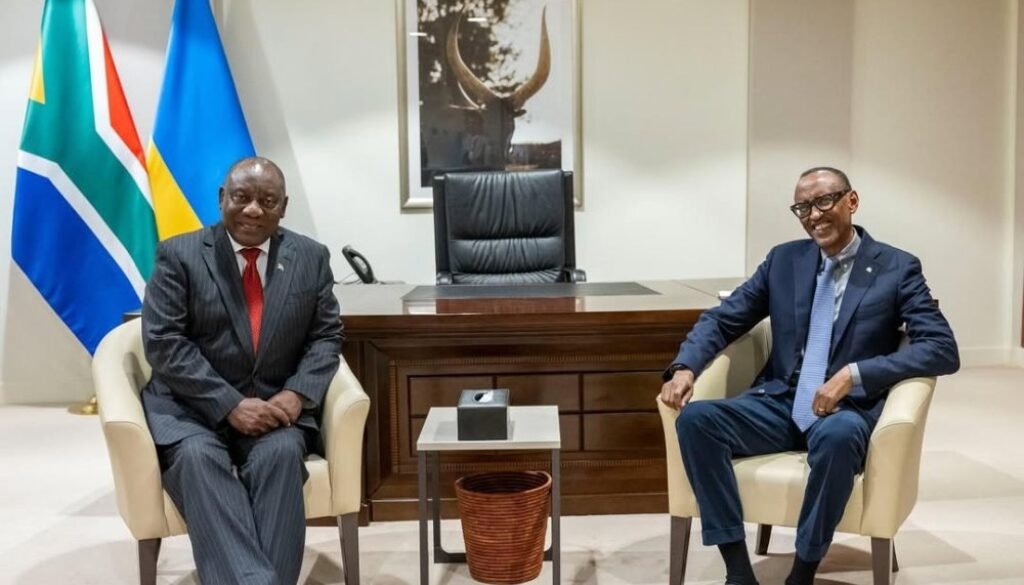
CAPTION: President Paul Kagame and Cyril Ramaphosa have, on several occasions, held discussions despite periods of strained relations between Rwanda and South Africa.
By Agencies
PRETORIA – Rwanda and South Africa are set to hold bilateral talks in Pretoria as part of ongoing efforts to rebuild and strengthen relations between the two countries following years of diplomatic tensions.
According to South Africa’s Department of International Relations and Cooperation, Minister Ronald Lamola will host Rwanda’s Foreign Affairs Minister, Olivier Nduhungirehe, in Pretoria on Wednesday, June 17, as part of efforts to strengthen bilateral relations between the two countries.
“The meeting forms part of ongoing efforts to rebuild and strengthen bilateral relations between South Africa and Rwanda. Discussions will focus on enhancing diplomatic engagement and advancing cooperation in priority areas, including trade, tourism, health, education, and security,” the department said in a statement.
At the conclusion of the meeting, Lamola is expected to address the media and outline the outcomes of the bilateral discussions, as well as provide perspectives on the way forward in strengthening relations between the two countries.
The talks come at a time when relations between Rwanda and South Africa have been strained for several years. Rwanda has repeatedly accused South Africa of providing a safe haven to individuals and groups it says are involved in activities aimed at undermining its security.
In recent years, tensions have also been fueled by disagreements over the conflict in eastern Democratic Republic of the Congo, where South African troops were deployed as part of the Southern African Development Community (SADC) mission supporting the Congolese government and its allies against the AFC/M23 rebel movement.
Rwanda has repeatedly warned South Africa against involvement in what it describes as a conflict that included plans to threaten Rwanda’s security.
Kigali has pointed to stockpiled weapons discovered after AFC/M23 forces captured the city of Goma as evidence supporting its concerns.
Relations deteriorated further in January 2025 when South African President Cyril Ramaphosa confirmed that his country had lost 13 soldiers in the volatile region and referred to the Rwanda Defence Force (RDF) as a militia while commenting on the fighting in eastern Congo.
He attributed the escalation of violence to the M23 rebel group and what he referred to as the “Rwanda Defence Force (RDF) militia.”
He framed South Africa’s military engagement under the Southern African Development Community Mission in the DRC (SAMIDRC) as a peacekeeping effort aimed at stabilizing the region.
However, in his response on X last year, Kagame dismissed these claims, asserting that ‘the RDF is an army, not a militia’.
He further criticized SAMIDRC’s role in the conflict, stating, “SAMIDRC is not a peacekeeping force, and it has no place in this situation. It was authorized by SADC as a belligerent force engaging in offensive combat operations to help the DRC Government fight against its own people, working alongside genocidal armed groups like FDLR which target Rwanda.”
During the withdrawal of South African and other SADC troops from eastern Congo after setbacks on the battlefield, Rwanda facilitated their transit through its territory as they returned home.
The diplomatic tensions have also had practical consequences, with Rwandan travelers facing difficulties obtaining visas to South Africa.
In May, Ramaphosa publicly acknowledged challenges in relations between the two countries while speaking during the Africa CEO Forum in Côte d’Ivoire, where he met Kagame.
“People may think that President Kagame and I are in conflict, and some of you may have thought that there’s going to be fireworks as we’re sitting close to each other,” Ramaphosa said, suggesting that despite existing differences, dialogue between the two countries remains important.
The meeting in Pretoria is expected to provide an opportunity for both sides to address outstanding concerns and explore ways of strengthening cooperation across areas of mutual interest.