Uganda seeks Dangote’s backing
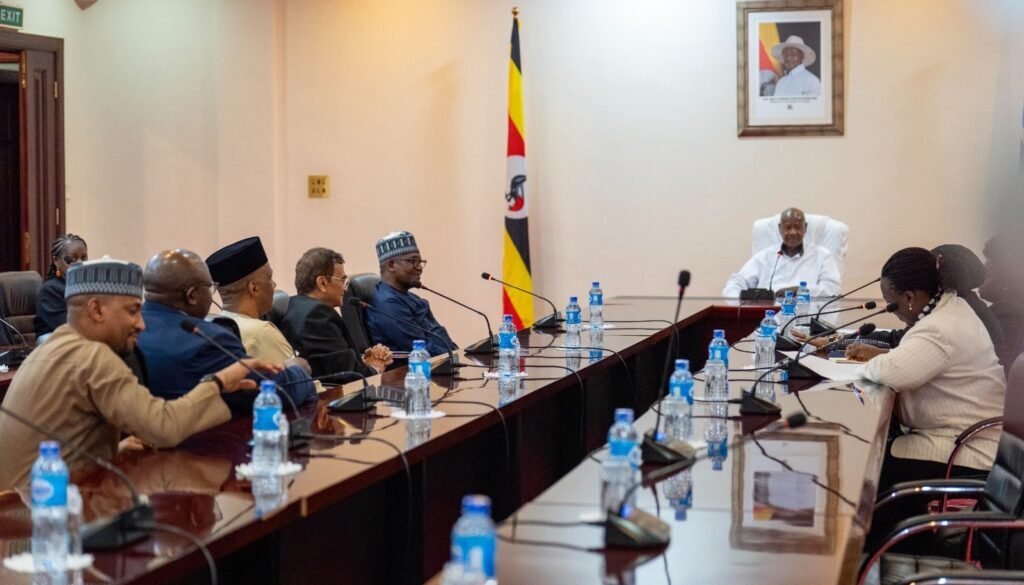
CAPTION: Nigerian billionaire Aliko Dangote meets Ugandan President Yoweri Museveni at State House Entebbe on Tuesday, November 17, 2026. PHOTO/@KagutaMuseveni/X
By our reporter
KAMPALA – Ugandan President Yoweri Museveni has held talks with Nigerian billionaire Aliko Dangote over potential investments in the country’s petroleum, energy, agriculture and mining sectors, as Kampala seeks to accelerate its industrialisation plans.
In a statement published on Wednesday, November 18, 2026, Museveni revealed that he met Dangote a day earlier to discuss several investment opportunities, including the possibility of establishing fertiliser manufacturing facilities to strengthen regional food security.
The discussions also covered Uganda’s proposed crude oil refinery, which is expected to process 60,000 barrels of oil per day once completed.
“Yesterday, I held discussions with Alhaji Aliko Dangote on several investment opportunities across energy, petroleum, agriculture and mining,” Museveni stated.
The Ugandan leader added that he had briefed the Nigerian industrialist on progress towards developing the refinery, which is planned for Kabaale in Hoima District.
“Furthermore, I highlighted the progress being made in developing the crude oil refinery, with an initial capacity of 60,000 barrels per day, in the country,” he added.
Uganda seeks Dangote’s expertise
Dangote’s visit followed an invitation by Ugandan government officials for his conglomerate to explore investment opportunities in the country.
According to reports, State Minister for Privatisation and Investment Hajjat Aminah Mukalazi received the billionaire at Entebbe International Airport on Tuesday, November 17, 2026, before he held discussions with Museveni at State House Entebbe.
The engagement came after a Ugandan delegation led by Energy and Mineral Development Minister Monica Musenero visited Dangote’s refinery and fertiliser facilities in Lekki, Lagos, on November 14, 2026.
Uganda is seeking partnerships in oil refining, fertiliser blending, phosphate processing and salt manufacturing.
Officials believe Dangote’s experience in financing, constructing and operating large industrial facilities could help the country turn its natural resources into finished products, create employment and expand local manufacturing.
However, no investment agreement or financial commitment by Dangote had been announced following the meeting.
Statement on President Yoweri Museveni’s meeting with Nigerian billionaire Aliko Dangote to discuss investment opportunities in Uganda. PHOTO/Screengrab by PD Digital/@KagutaMuseveni/X
Uganda’s proposed refinery is being developed through a joint venture between the state-owned Uganda National Oil Company (UNOC) and Alpha MBM Investments from the United Arab Emirates.
Under an agreement signed in March 2025, Alpha MBM holds a 60 per cent stake, while UNOC owns the remaining 40 per cent.
The approximately $4 billion (Ksh516 billion) project is expected to process 60,000 barrels of crude oil daily and reduce Uganda’s dependence on imported petroleum products.
The refinery has faced delays, with the latest target for a Final Investment Decision set for February 2027. Its development will require the completion of key commercial agreements and financing arrangements.
It remains unclear whether Dangote’s potential involvement would result in an additional investment, a strategic partnership or another form of industrial cooperation with the existing project partners.
Dangote’s growing East African refinery interests
The discussions come as Dangote advances plans for a much larger petroleum refinery in Lamu County, Kenya.
Kenya travel guide
The proposed Dangote East Africa Refinery, launched in September 2026, is designed to process 700,000 barrels of crude oil per day, with an estimated investment of Ksh2.2 trillion.
Museveni previously backed the project, arguing that refineries in Kenya, Uganda and Tanzania could complement one another and strengthen regional energy security.
The Ugandan president has maintained that African countries should process more of their natural resources locally instead of exporting raw materials and importing finished products.
Dangote’s latest engagement with Kampala signals further efforts to expand his industrial footprint across East Africa, although the details of any new Ugandan investment remain subject to further discussions.