Uganda surpasses 71 per cent safe water target
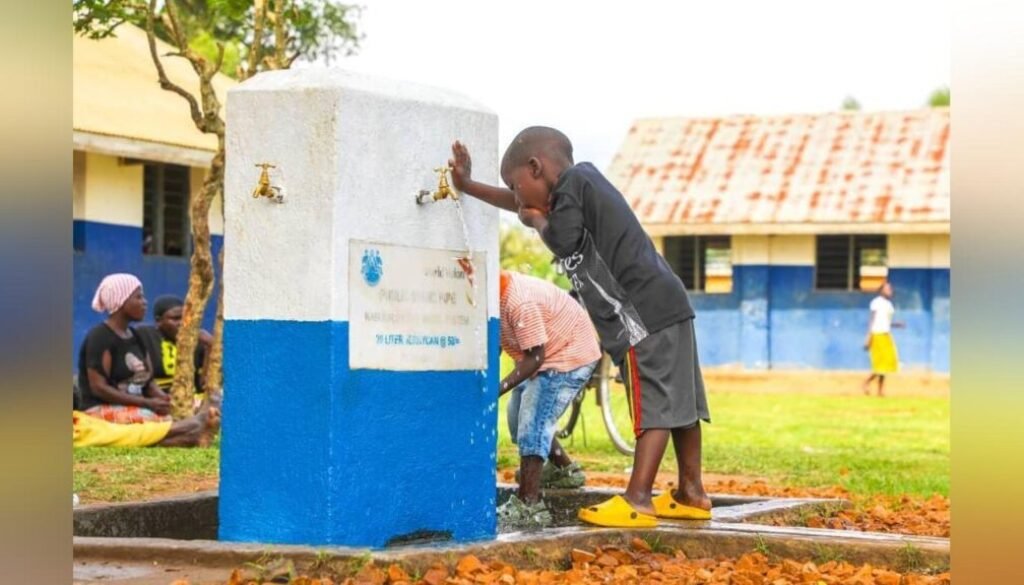
CAPTION: A child takes water from a safe access point in Soroti, eastern Uganda recently. (File Photo).
By Our reporter
KAMPALA – Over seventy per cent of Ugandans now have access to safe water, Parliament has been told. According to the Ministry of Water and Environment’s performance report, national safe-water access rose from 71.2 per cent to 73.6 per cent, exceeding the annual 71 per cent target.
The Minister of Water and Environment, Hon. Kahinda Otafiire presented the report to Parliament during the plenary sitting chaired by Speaker Jacob Marksons Oboth, on Wednesday, 30 September 2026.
The report also showed that rural access increased to 72 per cent, urban access reached 75.2 per cent, and coverage in refugee and host communities hit 76 per cent with facility functionality at 85, 92 and 91 percent in these respective areas, thanks to National Water and Sewerage Corporation as well as its partners.
The report said, also rehabilitated 27 piped systems and 1,238 rural point-water facilities, restoring reliable access for an estimated 464,443 people.
“Despite these headline gains, 12,339 of Uganda’s 77,225 villages and cells still lacked a single improved safe-water source by June 2026,” Otafiire said
He noted that these unserved communities are increasingly concentrated in remote, sparsely populated areas where infrastructure extension costs are high.
To solve this, Otafiire proposed moving beyond boreholes, saying that pumping water from major lakes and rivers to areas like Karamoja would provide long term water solutions.
“it’s a shame that we have people dying of hunger in Karamoja, when major water sources are nearby,” he said.
Whilst the lawmakers appreciated the report, they urged for immediate intervention, emphasising the need for safe drinking water, more borehole funding access to piped water and preparedness for floods and mudslides.
The MP for Mityana Municipality, Hon. Francis Zaake, decried the manner in which MPs have been forced to use their resources to buy water bowsers in their constituencies. “The ministry should provide water bowsers to every district since this is a service they should give”, he said.
Minister Kahinda Otafiire on the Floor of Parliament on Wednesday, 30 September 2026
Hon. Amelia Kyambadde described her constituency of Mawokota County North as “water-stressed,” noting that island residents still drink contaminated lake water.
Sustainability, Hon. Asha Mafabi (NRM, District Woman Representative, Sironko) emphasised, is the deeper challenge. “Projects often collapse due to inadequate supervision and weak oversight,” she said.
Bulambuli County MP, Hon. Emmanuel Biara, tasked the government to demonstrate its readiness for the October rains saying Elgon region has endured mudslides since 2010.
“I have not clearly seen the actions the minister is proposing for the rains that are going to come, kill people and destroy property,” he said.
In response, the minister said that to strengthen early warnings for agriculture and disaster management, 11 automatic weather stations were commissioned, raising the national total to 234 across 104 districts.
Additionally, the ministry will focus on extending water to the remaining 12,339 unserved villages, protecting infrastructure, scaling up water-for-production schemes, restoring degraded ecosystems, and tightening wastewater and air-quality monitoring.