Agent banking rewrites Uganda’s economic
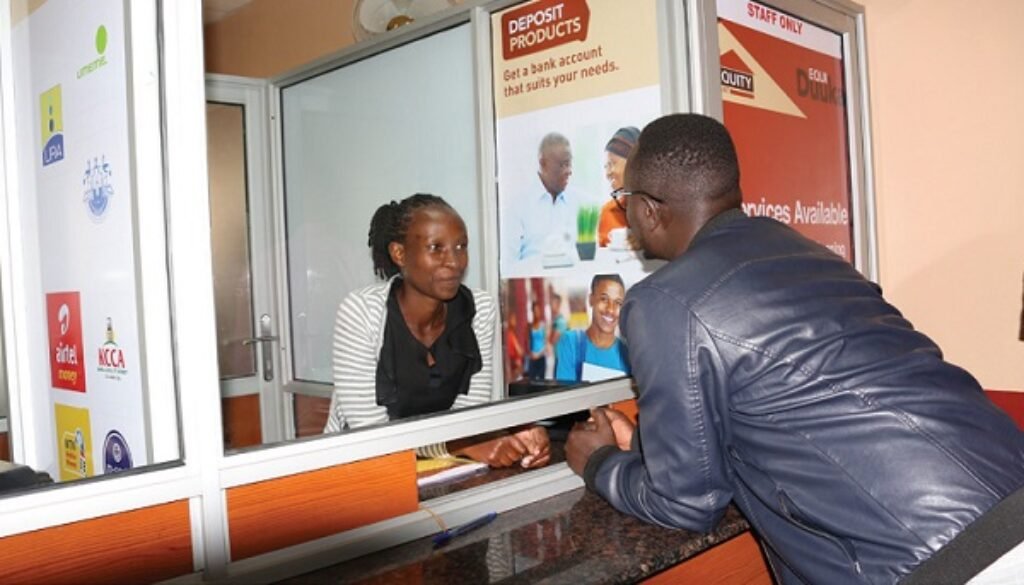
CAPTION: Equity Bank client being served by an agent banker recently. (File photo).
By Theresa Nalwanga
KAMPALA – Walk into a small shop in Gulu or Mbarara around 8 a.m., and you will see something that did not exist five years ago. A mother hands over cash to pay her child’s school fees. The shopkeeper taps a POS machine, and the funds hit the school’s account instantly. There are no bank queues and no long, expensive bus rides to town. A transaction that once took half a day is completed in minutes.
That shopkeeper is not a traditional banker, but she has become the most critical financial service point in her community. She opens before the nearest brick-and-mortar branch, closes long after it, and knows her customers by name.
Agency banking has evolved far beyond simple cash withdrawals. Today, retail agents enable traders to settle with suppliers digitally, allow farmers to secure harvest earnings immediately after market day, and support local schools by streamlining seasonal fee collections.
The macroeconomic data reflects this shift. According to the Bank of Uganda, agent banking transactions in the country jumped 76% in 2025, rising from UGX 16.7 trillion to UGX 29.4 trillion, while transaction volumes climbed 50.5% to 12.5 million. This steep growth demonstrates that when financial services are physically proximate, customer adoption and deposit performance scale naturally.
The reality of the Ugandan market makes this proximity essential. Currently, Kampala holds roughly 80% of the country’s commercial bank branches, leaving the rest of Uganda to share the remaining 20%. This geographic imbalance leaves millions underserved. Agents bridge this gap by operating directly in villages, agricultural markets, and transport hubs, places where building a physical branch is financially impractical.
In rural Kapchorwa, farmers now deposit grain-sale proceeds without traveling to Soroti. In Mbarara market, boda riders receive payments through agents via POS terminals or USSD codes. Because these services are embedded where commerce actually happens, trust has deepened. Customers regularly trust agents with salary payments, large supplier settlements, and formal agricultural transactions. In northern Uganda, the model has even brought informal financial activities into the regulated space by digitizing transactions for SACCOs and Voluntary Savings and Loan Associations (VSLAs), building a verifiable paper trail for groups that previously operated on trust alone.
To capture this momentum, financial institutions are upgrading their underlying architecture. KCB Group has transitioned from localized systems to a unified agent banking platform powered by a robust regional backend. This infrastructure links operations across Kenya, Uganda, Tanzania, Rwanda, Burundi, and South Sudan into a single network.
For the local agent, a unified regional platform means lower operational downtime, faster onboarding, and more reliable multi-channel access points, whether through a POS terminal, mobile app, web interface, or USSD codes.
Crucially, this model transforms the economics of the retail shop itself. Operating an agency point introduces a steady, secondary revenue stream, with typical agents earning between UGX 50,000 and 150,000 monthly in commissions. This liquidity is frequently reinvested back into the primary business used to buy stock, expand retail space, or hire additional staff.
However, resolving the micro-transaction barrier through agency banking is only the first step. The deeper challenge for rural enterprises, particularly the schools and small businesses anchoring these communities, remains structured credit. Seasonal cash flow mismatches such as a school waiting for term fees while facing immediate operational costs require practical financing that matches real-world business cycles.
To support this ecosystem, KCB Bank Uganda structures its commercial lending around these exact operational bottlenecks. By leveraging the transaction visibility gained through our expanding network, the bank offers targeted credit facilities: bridge financing to cover short-term cash flow gaps, development loans for infrastructure expansion, and asset financing for equipment or vehicles.
True financial inclusion cannot be achieved through digital applications alone, nor can it rely entirely on physical bank branches. The future of banking in Uganda is a blended model, one that is digitally secure, regionally unified, but fundamentally human and embedded where local business actually happens.

By Theresa Nalwanga, Agency Banking Manager, KCB Bank Uganda