Ruto banks on Kenya-Somali elites
By Agencies
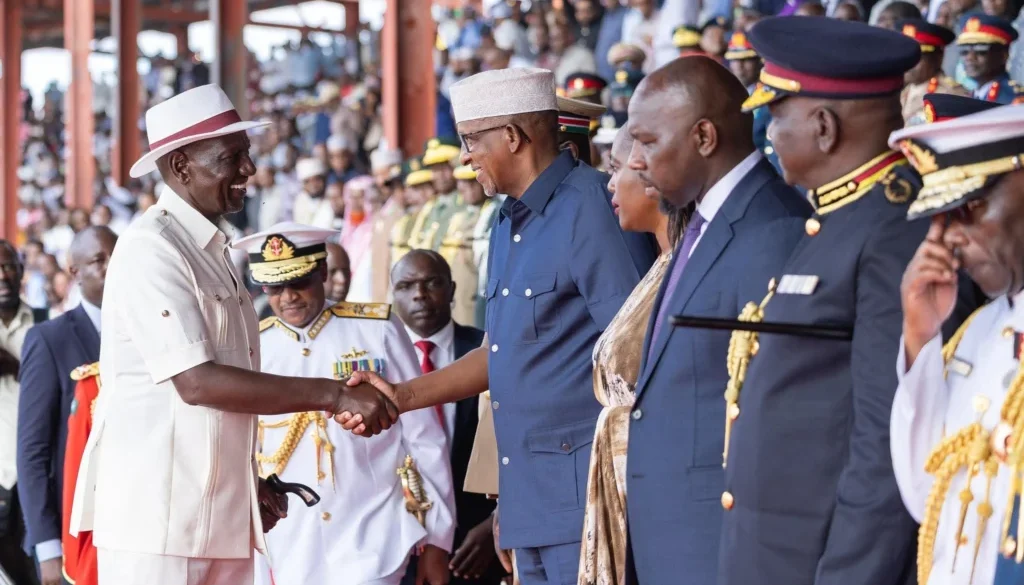
WAJIR – During his Madaraka Day speech on 1 June 2026 in Wajir, marking Kenya’s 63rd anniversary of internal self-rule, President William Ruto spoke emotionally about the occasion. Wajir Governor Ahmed Abdullahi Jiir similarly described the event as historic, being the first Madaraka Day celebration held in Kenya’s northern region.
The occasion featured familiar promises of development: a new university, support for Quranic teachers and madrassa schools, and the continued suspension of the controversial vetting process for national ID and passport applications in the region. Governor Jiir bestowed upon Ruto the title of Sultan and pledged that Wajir elders would present the president with 100 camels.
Longer-term shift
While these gestures have been framed as evidence of a new relationship between Kenya’s historically marginalised northeast and the more affluent south, they are better understood as part of a longer-term shift involving interconnected political, security, and business interests.
Many observers have interpreted Ruto’s outreach to the predominantly Somali population of Northeast Kenya through the lens of the 2027 general election. Having lost support in parts of Central Kenya following his split with former deputy president Rigathi Gachagua, Ruto may be seeking to strengthen his electoral position in previously neglected regions.
Opposition leader Kalonzo Musyoka has gone further, alleging that the government plans to import voters from Somalia — a claim linked to the abolition of the vetting process and proposals to reopen the Kenya–Somalia border.
Beyond electoral calculations, however, the growing prominence of Kenyan-Somali elites within Ruto’s administration deserves closer attention.
When Ruto assumed office in 2022, he appointed his close ally Aden Bare Duale as defence cabinet secretary. Although now health cabinet secretary, Duale remains one of the most influential Somali figures in government. Alongside him is a wider network of political, business, and technocratic elites who supported Ruto’s presidential campaign and have since secured senior appointments and government contracts.
Kenyan-Somalis now lead key state institutions, including the Kenya Revenue Authority (KRA), the Directorate of Criminal Investigations (DCI), the Ethics and Anti-Corruption Commission (EACC), and the National Intelligence Service (NIS).
No longer marginalised
As a result, Northeast Kenya and the Kenya–Somalia borderlands are no longer viewed as peripheral spaces. Somali political capital has become increasingly influential within Nairobi, shaping policy both toward the region itself and toward neighbouring Somalia.
This development builds on an older tradition of elite influence from the northeast. Figures such as General Mahmoud Mohamed, former defence minister Mohamed Yusuf Haji, and now their successors have long occupied important positions within the Kenyan state. Under Ruto, however, this influence appears more extensive and institutionalised.
These networks operate across borders and often independently of formal state structures
The rise of these elites is also tied to economic power. Analysts such as Parselelo Kantai and Neil Carrier have documented the growth of Somali capital through commercial networks linking Northeast Kenya, Eastleigh in Nairobi, and cities in southern Somalia. These networks operate across borders and often independently of formal state structures. Their expansion has increased the strategic importance of Northeast Kenya for both business and political actors.
This context helps explain the significance of efforts to reopen the Kenya–Somalia border. In February 2026, Ruto announced that the border would reopen after nearly 15 years of official closure, though the decision was later postponed amid political tensions and security concerns in Somalia.
Borderland political economy
The proposal reportedly divided Kenya’s national security council. Security officials warned of risks associated with militant activity, while politicians aligned with the president emphasised economic and political benefits. Duale is widely believed to have been a key advocate of reopening the border, fulfilling a promise made to residents of the northeast during Ruto’s presidential campaign.
The borderlands today are far from isolated frontiers. They constitute a complex political economy shaped by kinship ties, informal trade, and local arrangements that connect communities across Kenya and Somalia. Because both regions are distant from their national capitals, cross-border exchange often provides cheaper access to goods and services than formal national markets.
Despite the border’s official closure since 2011, trade has continued through areas such as Liboi, Hulugho, and Kulbiyo. Livestock, agricultural products, construction materials, sugar, powdered milk, and other goods routinely cross the frontier. Informal arrangements also facilitate education, healthcare, and pastoral mobility. Yet these same networks can enable smuggling, corruption, and the movement of militant actors.
For supporters, reopening the border represents an opportunity to formalise these exchanges through regulated crossings, standardised trade procedures, and improved infrastructure. Such reforms could increase efficiency and transparency.
However, formalisation may also create opportunities for politically connected elites to dominate sectors that have historically been accessible to smaller traders. Business interests linked to influential figures could benefit disproportionately from new regulatory frameworks and expanded cross-border commerce. In this sense, reopening the border is not merely a matter of trade policy but also a struggle over who will control the economic future of the borderlands.
The growing importance of Northeast Kenya therefore reflects more than electoral strategy. The region has become central to a broader constellation of interests spanning politics, security, and commerce. Once regarded as marginal, the Kenya–Somalia borderlands now occupy an increasingly important place in the calculations of both national leaders and powerful business networks.